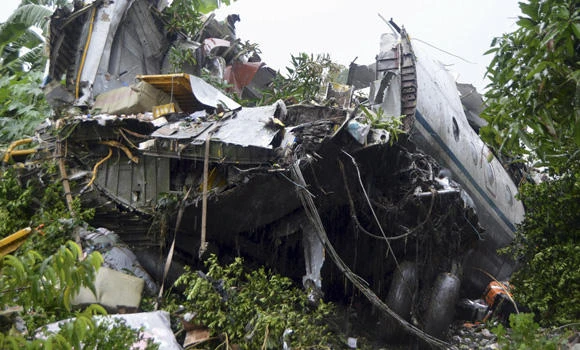
JUBA, South Sudan: A cargo plane that was reportedly overloaded crashed along the banks of the Nile River after taking off from the South Sudan’s capital, killing dozens of people.
A Reuters report said a witness saw 41 bodies, some of which were covered by cloth. A police officer, who did not give his name because he was not authorized to speak to the media, also put the death toll at 41.
The Civil Aviation Authority said the number of dead was still being counted. But the South Sudan Red Cross said 36 bodies have been retrieved by rescuers so far.
“So far 36 bodies have been collected and brought to hospitals,” Red Cross official Majju Hillary told AFP.
Two survivors were pulled out of the twisted metal hulk of the plane but one of those later died, with a young boy the only survivor, the Red Cross said, adding the number of dead may still rise.
“We can’t assess this is the final toll, as some debris is too heavy to be lifted and needs some heavy machinery,” Hillary added.
The five-member Armenian crew were all killed, the Armenian Embassy in Egypt said in a statement.
An Associated Press reporter at the scene of the crash saw the bodies, including those of women children.
Presidential spokesman Ateny Wek Ateny told Reuters the plane was carrying 18 people, including the six foreign crew, according to official documents. He said 15 of them died and three South Sudanese nationals survived, including a child.
“This is the number given to us by the (control) tower,” he said in reference to those on board. Asked about figures suggesting a higher toll, he said it could be people killed on the ground but said he had no indication about any such deaths.
Officials said the plane belonged to freight and logistics firm Allied Services Ltd. Officials at the company could not immediately be reached for comment.
“We have rushed to the site of crash which is located near the airport, southeast of Juba International Airport (across) the river,” said the chief executive of the Civil Aviation Authority at Juba airport, Stephen Warikozi.
“We have secured the site of crash and also we are in the stage of recovering bodies and black box,” he said. “We are still now recovering the dead bodies and we cannot give you the exact number.”
The plane, registration number EY406, had been on its way to Paloch, in the north of South Sudan, Warikozi said.
The presidential spokesman said the six crew were comprised of five Armenians and one Russian.
Parts of the plane were scattered in a bushy area on banks of the Nile with a few homes nearby. Packages of cheap sandals, cigarettes, beer and crackers were strewn amid the wreckage. The white tail section protruded from the brush.
Bashir Yashin, who saw the plane come down, said it seemed as though initially the plane might crash into a market area before the pilot apparently diverted it. Another witness, Angelo Kenyi, said a child, who looked no more than a year old, and an elderly woman were pulled from the fuselage.
Presidential spokesman Ateny Wek Ateny said the plane had been bound for the Paloich oil fields in Upper Nile state. Rebels and government forces have been battling for control of Upper Nile state. Juba, the capital, has been peaceful recently.
Russian television channel LifeNews quoted an unnamed source at the Russian aviation agency as saying that the plane appeared to have been overloaded and that it was made in the Soviet Union in 1971. There has been no official reaction from Russian authorities so far.
It is common for the security services to put family members on the cargo planes to Paloich even if they are not on the manifest, according to Kenyi Galla, assistant operations manager for Combined Air Services, a company that operates chartered flights across South Sudan. The doomed flight was not chartered by his company, Galla said..
“Normally (this flight) used to carry 12 people, but the problem is they added more people,” he said. “This plane is just for cargo, not for passengers. It was just chartered for goods.”
Many parts of South Sudan, which became an independent nation in 2011, have been hit by violence since December 2013, with government forces under President Salva Kiir battling rebels led by his former deputy, Riek Machar. Fighting persists despite a peace agreement signed in August.
Dozens killed in South Sudan cargo plane crash