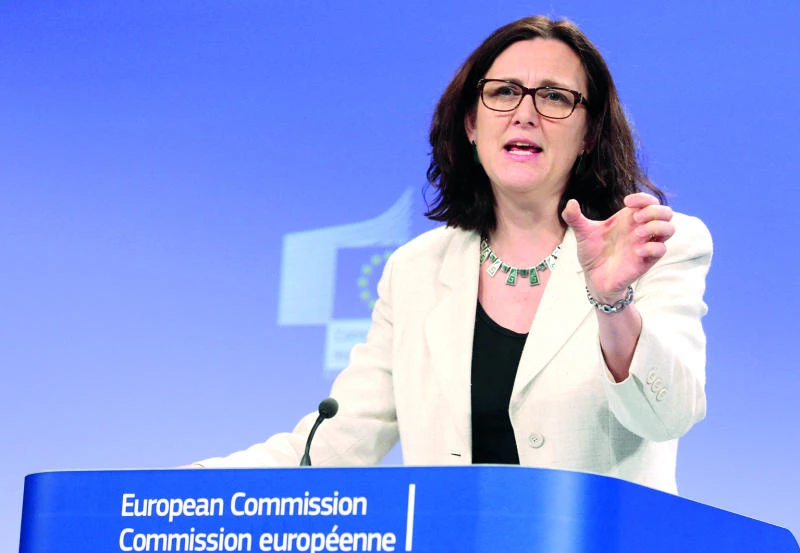
BRUSSELS/LONDON: The European Union’s executive arm is calling for stronger,coordinated action to combat what it calls the rising threat of violent political extremism in Europe.
EU home affairs commissioner Cecilia Malmstrom said Wednesday too few EU member countries are facing up to the threat.
She says the bloc needs “strong, preventive measures to counter extremism in all its forms.”
Malmstrom and other EU commissioners want the European Union and its 28 member states to act in 10 areas. Among them: creation of an EU-wide “knowledge hub” to share best practices on dealing with political extremism, support for “exit strategies” to help people leave potentially violent groups, and using the Internet to fight extremist propaganda.
The commission says it’s willing to spend up to 20 million euros ($27 million) on the program.
British finance minister issues EU warning
Finance Minister George Osborne meanwhile warned Wednesday that the EU faces terminal decline and risks losing Britain as a member unless the bloc introduces urgent reforms.
Osborne, whose government has promised a referendum on membership in 2017, said the 28-member European Union was becoming less competitive than China and India.
The Conservative chancellor of the exchequer added that the bloc’s treaties were “not fit
for purpose” and had to be rewritten.
“We can’t go on like this,” he told a London conference on EU reform organised by two eurosceptic groups.
“The biggest economic risk facing Europe doesn’t come from those who want reform and renegotiation, it comes from a failure to reform and renegotiate.
“It is the status quo which condemns the people of Europe to an ongoing economic crisis and continuing decline. And so there is a simple choice for Europe: Reform or decline.
“Our determination is clear: To deliver the reform, and then let the people decide.”
Prime Minister David Cameron has promised to renegotiate the terms of Britain’s membership of the EU before putting them to the country in an in/out referendum by the end of 2017, provided that his Conservative Party wins the next general election in May 2015.
Osborne highlighted Europe’s lack of competitiveness as a particular problem.
“Over the last six years, the European economy has stalled,” he said at the conference held by Open Europe and the Fresh Start Project.
“In the same period, the Indian economy has grown by a third. The Chinese economy by nearly 70 percent.
“Make no mistake, our continent is falling behind.”
He said that reforms were needed to put the euro on a “firmer footing” after the crisis that engulfed the single currency, but that it was also vital for states like Britain that do not use the euro currency to be given legal protection.
Osborne repeated Cameron’s warnings that without reform Britain could be forced out of the EU.
“The European treaties are not fit for purpose,” he said.
“Eurozone integration is necessary if the euro is to survive. But proper legal protection for the rights of non-euro members is absolutely necessary to preserve the single market and make it possible for Britain to remain in the EU.
“I believe it is in no-one’s interests for Britain to come to face a choice between joining the euro or leaving the European Union... And a country of the size and global reach of Britain leaving would be very bad for the European Union.”
Britain is at loggerheads with Brussels on a host of issues ranging from the economy to migration from newer EU members Romania and Bulgaria.
But the issue is also hugely divisive for the Conservatives, who are in an uneasy coalition government with the pro-EU Liberal Democrats.
More than 90 backbench Conservative lawmakers wrote to Cameron at the weekend demanding that the British parliament should be given a veto over all EU laws.
The government rejected the demand, with Foreign Secretary William Hague saying it would damage the single market.
EU vows to deal with rising tide of extremism in Europe