BRUSSELS/KIEV: European Commission President Jose Manuel Barroso on Wednesday called for an end to violence in Ukraine and warned the authorities that the EU executive would assess “possible actions.”
“We are shocked to hear the latest news from Ukraine about deaths of protesters ... and deplore in the strongest possible terms the use of force and violence,” Barroso told reporters.
Saying the situation was worsening, the head of the European Union executive said he wanted “to explicitly underline” the responsibility of the authorities “to de-escalate this crisis” and the need for them to begin “a genuine dialogue” to overcome the crisis.
“We are genuinely concerned about where these developments are taking Ukraine and will continue following closely these developments, as well as assessing possible actions by the EU and consequences for our relations.”
Asked later what concrete action he was mulling, Barroso said it was “premature” to decide a course of action, which would need a general consensus.
The Foreign Ministry of Lithuania, which has played a prominent role in EU efforts to seal a partnership deal with Ukraine that is at the root of the protests, earlier said consultations were taking place in the EU over possible actions. But at talks between EU foreign ministers on Monday there was no consensus on such a move.
The EU Enlargement Commissioner Stefan Fuele will visit Ukraine on Friday and Saturday to discuss recent developments, his office said. He will meet representatives of the authorities and opposition, as well as representatives of civil society.
Earlier, EU foreign policy chief Catherine Ashton also called for “an immediate end” to the escalating violence in Ukraine after the deaths of two people in clashes between police and pro-EU protestors.
“The use of force and resort to violence is not an answer to the political crisis. All acts of violence must come to an immediate end and be swiftly investigated. Those responsible will have to be held to account,” she said in a statement.
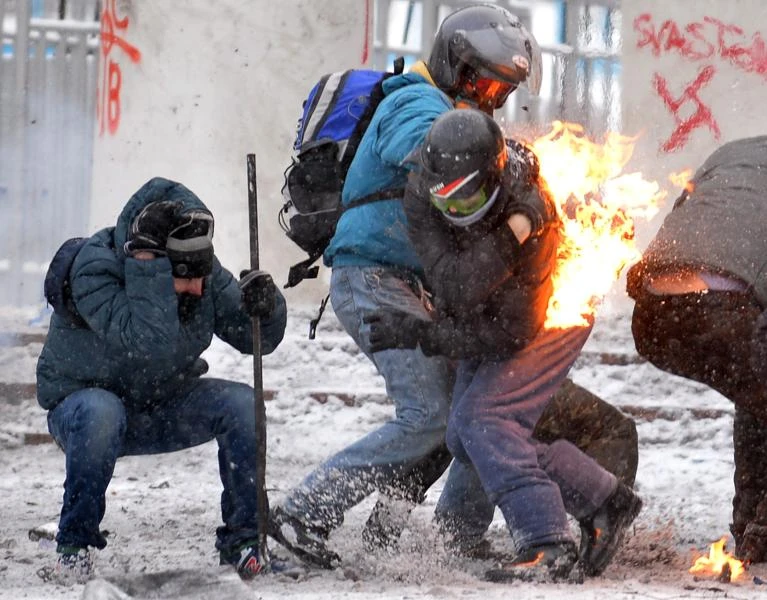
Two activists were shot dead as Ukrainian police stormed protestors’ barricades, the first fatalities since the start of protests over President Viktor Yanukovych’s failure to sign a deal for closer ties with the EU.
Joining the chorus of protests, NATO Secretary General Anders Fogh Rasmussen too condemned developments in Ukraine, saying “violence can never be the answer to a political crisis.”
Prosecutors say two men who died at site of Kiev clashes were shot with live ammunition.
Timeline of key events
Here are the key dates that have shaped the protests:
Nov. 21, 2013: President Viktor Yanukovych’s cabinet announces that they are abandoning an agreement that would strengthen ties with the EU, and instead seek closer cooperation with Moscow.
Nov. 30: Police launch a brutal attack on protesters, detaining 35. Images of protesters bloodied by police truncheons spread quickly and galvanize public support for the demonstrators. A demonstration on Dec. 1 attracted around 300,000 people, the largest protest in Kiev since the Orange Revolution in 2004.
Dec. 17: Russian President Vladimir Putin announces that Moscow will buy $15 billion worth of Ukrainian government bonds and allow for a sharp cut in the price Ukrainians will have to pay for Russian natural gas. Putin and Yanukovych claim that there were no conditions attached to the agreement, which did not require Ukraine to join a Russia-led free trade pact.
Jan. 22, 2014: Two protesters die after being hit with live ammunition and the third after a fall during a confrontation between police and demonstrators manning barricades, the first protest deaths. (AP)
EU warns Ukraine of ‘actions’