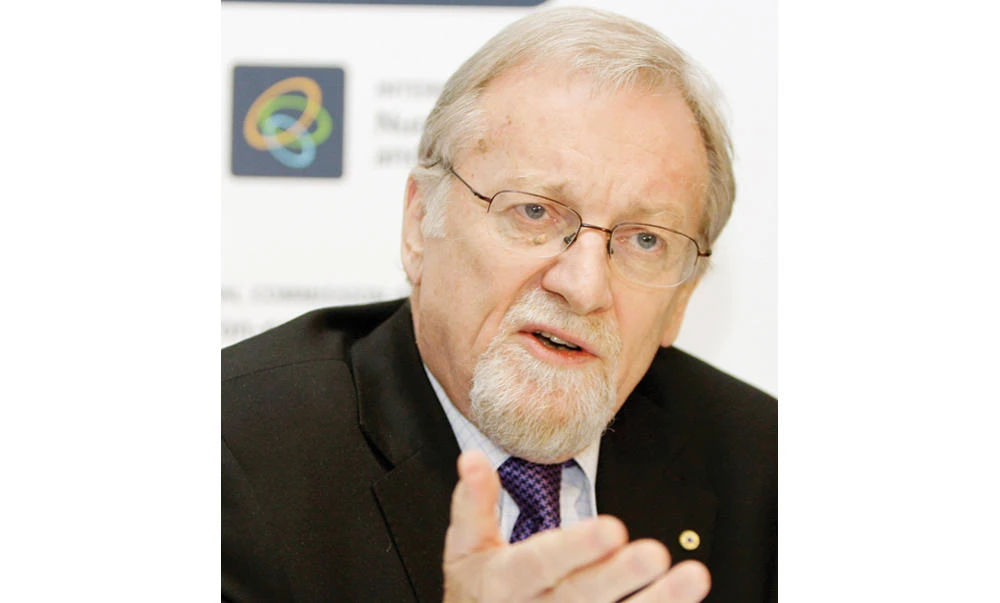
SYDNEY: A former Australian foreign affairs minister has dubbed Donald Trump the most “psychologically ill-equipped president” in American history, and called on Australia to distance itself from the US in favor of forging closer ties with China.
Gareth Evans, who served as Australia’s foreign minister from 1988 to 1996, urged Australia to become more independent, back away from its longtime reliance on the US and instead recognize China as a “global rule-maker.”
In a speech to the National Press Club in Canberra, Evans questioned whether Australia’s historically close alliance with the US still serves the nation’s interests amid China’s rising power and Trump’s unpredictable leadership.
“The Australia-United States alliance has become much more immediately salient since the election of Donald Trump — manifestly, the most ill-informed, underprepared, ethically challenged and psychologically ill-equipped president in the United States history,” said Evans, who is now the chancellor of the Australian National University. “Personally driven by instinct and impulse, unhampered by knowledge or judgment, he has led an administration acting so far manifestly on the basis of postures, not of policies.”
Australian Prime Minister Malcolm Turnbull has repeatedly rejected arguments that Australia must choose between its most important security partner, the US, and its most important trading partner, China, as tensions escalate between the economic superpowers.
Evans said Australia should not abandon its alliance with the US, but said the government should stop reflexively supporting everything the US does, such as Trump’s decision to launch missiles at a Syrian air base. Turnbull praised the strike as “a calibrated, proportionate and targeted response.”
The relationship between the longtime allies is at its lowest point in decades. Australia was disappointed by Trump’s decision to pull the US out of the 12-nation Trans-Pacific Partnership trade pact. Relations soured further following a widely publicized spat between Turnbull and Trump over a refugee resettlement deal struck by the previous Obama administration.
The countries will look to shore up relations during a visit to Australia next week by Vice President Mike Pence, who is also planning stops in Korea, Japan and Indonesia on a tour of the Asia-Pacific region.
Gareth Evans, who served as Australia’s foreign minister from 1988 to 1996, urged Australia to become more independent, back away from its longtime reliance on the US and instead recognize China as a “global rule-maker.”
In a speech to the National Press Club in Canberra, Evans questioned whether Australia’s historically close alliance with the US still serves the nation’s interests amid China’s rising power and Trump’s unpredictable leadership.
“The Australia-United States alliance has become much more immediately salient since the election of Donald Trump — manifestly, the most ill-informed, underprepared, ethically challenged and psychologically ill-equipped president in the United States history,” said Evans, who is now the chancellor of the Australian National University. “Personally driven by instinct and impulse, unhampered by knowledge or judgment, he has led an administration acting so far manifestly on the basis of postures, not of policies.”
Australian Prime Minister Malcolm Turnbull has repeatedly rejected arguments that Australia must choose between its most important security partner, the US, and its most important trading partner, China, as tensions escalate between the economic superpowers.
Evans said Australia should not abandon its alliance with the US, but said the government should stop reflexively supporting everything the US does, such as Trump’s decision to launch missiles at a Syrian air base. Turnbull praised the strike as “a calibrated, proportionate and targeted response.”
The relationship between the longtime allies is at its lowest point in decades. Australia was disappointed by Trump’s decision to pull the US out of the 12-nation Trans-Pacific Partnership trade pact. Relations soured further following a widely publicized spat between Turnbull and Trump over a refugee resettlement deal struck by the previous Obama administration.
The countries will look to shore up relations during a visit to Australia next week by Vice President Mike Pence, who is also planning stops in Korea, Japan and Indonesia on a tour of the Asia-Pacific region.