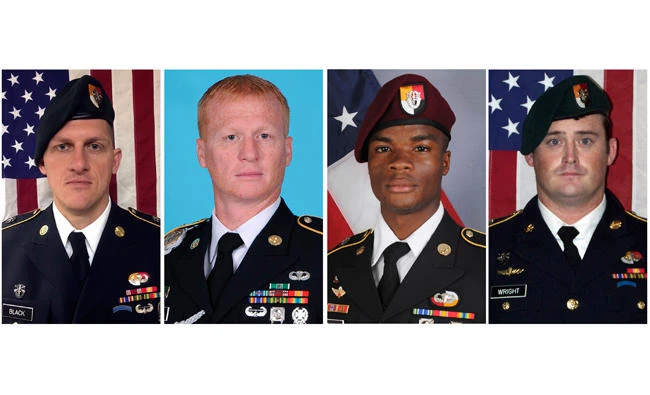
WASHINGTON: A military investigation into the Niger attack that killed four American service members concludes the team did not get required senior command approval for their risky mission to capture a high-level Daesh militant, several US officials familiar with the report said. It does not point to that failure as a cause of the deadly ambush.
Initial information suggested the Army Special Forces team set out on its October mission to meet local Nigerien leaders, only to be redirected to assist a second unit hunting for Doundou Chefou, a militant suspected of involvement in the kidnapping of an American aid worker. Officials say it now appears the team went after Chefou from the onset, without outlining that intent to higher-level commanders.
As a result, commanders could not accurately assess the mission’s risk, according to the officials who spoke on condition of anonymity to discuss the results of the investigation before they’re publicly released. The finding will likely increase scrutiny on US military activity in Africa, particularly the role of special operations forces who’ve been advising and working with local troops on the continent for years.
Four US soldiers and four Nigerien troops were killed Oct. 4 about 120 miles north of Niamey, Niger’s capital, when they were attacked by as many as 100 Daesh-linked militants traveling by vehicle and carrying small arms and rocket-propelled grenade launchers. Two other American soldiers and eight Nigerien forces were wounded.
The investigation finds no single point of failure leading to the attack, which occurred after the soldiers learned Chefou had left the area, checked his last known location and started for home. It also draws no conclusion about whether villagers in Tongo Tongo, where the team stopped for water and supplies, alerted Daesh militants to American forces in the area. Still, questions remain about whether higher-level commanders — if given the chance — would have approved or adjusted the mission, or provided additional resources that could have helped repel the ambush.
Army Col. Rob Manning, a Pentagon spokesman, wouldn’t comment on the investigation, beyond saying it’s now complete and being reviewed by Defense Secretary Jim Mattis and other senior leaders.
The other US officials said the final report could have consequences for US military operations in Africa.
Initial information suggested the Army Special Forces team set out on its October mission to meet local Nigerien leaders, only to be redirected to assist a second unit hunting for Doundou Chefou, a militant suspected of involvement in the kidnapping of an American aid worker. Officials say it now appears the team went after Chefou from the onset, without outlining that intent to higher-level commanders.
As a result, commanders could not accurately assess the mission’s risk, according to the officials who spoke on condition of anonymity to discuss the results of the investigation before they’re publicly released. The finding will likely increase scrutiny on US military activity in Africa, particularly the role of special operations forces who’ve been advising and working with local troops on the continent for years.
Four US soldiers and four Nigerien troops were killed Oct. 4 about 120 miles north of Niamey, Niger’s capital, when they were attacked by as many as 100 Daesh-linked militants traveling by vehicle and carrying small arms and rocket-propelled grenade launchers. Two other American soldiers and eight Nigerien forces were wounded.
The investigation finds no single point of failure leading to the attack, which occurred after the soldiers learned Chefou had left the area, checked his last known location and started for home. It also draws no conclusion about whether villagers in Tongo Tongo, where the team stopped for water and supplies, alerted Daesh militants to American forces in the area. Still, questions remain about whether higher-level commanders — if given the chance — would have approved or adjusted the mission, or provided additional resources that could have helped repel the ambush.
Army Col. Rob Manning, a Pentagon spokesman, wouldn’t comment on the investigation, beyond saying it’s now complete and being reviewed by Defense Secretary Jim Mattis and other senior leaders.
The other US officials said the final report could have consequences for US military operations in Africa.