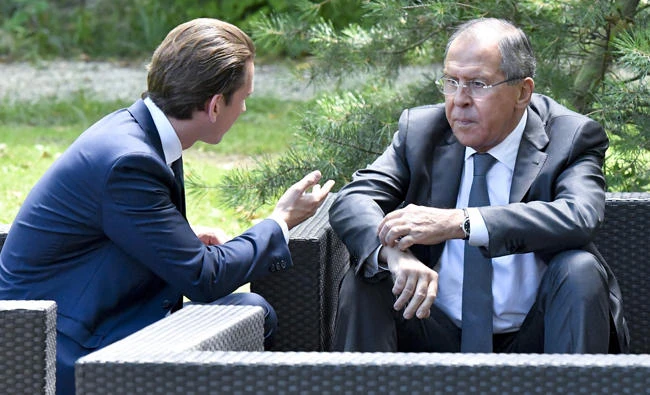
MAUERBACH, Austria: The Organization for Security and Co-operation in Europe (OSCE) sought Tuesday to break the deadlock over an unprecedented leadership crisis within the security body at an informal gathering of member states in Austria.
The meeting outside Vienna of 30 foreign ministers, including Russia’s Sergei Lavrov, also discussed escalating violence in eastern Ukraine, where the OSCE has a monitoring mission.
The OSCE has been without a chief since the mandate of former Secretary General Lamberto Zannier ended on June 30.
Several of the body’s 57 member states have blocked the appointment of a successor as they demand national concessions. Three other top OSCE posts also remain vacant because of the internal rifts.
Austria, the OSCE’s rotating chair and host of Tuesday’s meeting, said it will “put pressure” on the countries to solve the crisis.
“I will demand that my colleagues show some willingness to compromise,” Austrian Foreign Minister Sebastian Kurz told reporters ahead of the gathering at an upscale hotel.
“Those interested in a strong OSCE will need to accept compromises so that leading roles can be filled and the organization can carry out its work.”
Earlier this month, the OSCE’s outgoing secretary general said that the organization, created during the Cold War to ease dialogue between East and the West, risked becoming obsolete unless it “rethought its fundamentals.”
On Tuesday, Kurz warned that the OSCE was also facing a “crisis of confidence” over the bloody separatist conflict pitting pro-Russian rebels against Ukrainian government forces.
“We have a crisis of confidence within OSCE member states. The conflict in Ukraine has split our continent,” he said.
“I hope the European Union and Russia can find a way of growing closer. Peace on our continent is only possible with Russia.”
He reiterated the OSCE’s commitment announced earlier this year to boost its observer mission in eastern Ukraine from around 800 to 1,000 monitors.
The conflict as well as Russia’s annexation of Crimea from Ukraine in 2014 have pushed ties between Moscow and the West to their lowest point since the Cold War.
More than 10,000 people have been killed since the pro-Russian insurgency began in April 2014, which Kiev and the West accuse Moscow of orchestrating.
The US and the EU have imposed sanctions on Russia, though Moscow has denied backing the rebels.
Absent from the meeting in Mauerbach were US Secretary of State Rex Tillerson, EU Foreign Policy Chief Federica Mogherini and the foreign ministers of France, Germany and Britain.
The meeting outside Vienna of 30 foreign ministers, including Russia’s Sergei Lavrov, also discussed escalating violence in eastern Ukraine, where the OSCE has a monitoring mission.
The OSCE has been without a chief since the mandate of former Secretary General Lamberto Zannier ended on June 30.
Several of the body’s 57 member states have blocked the appointment of a successor as they demand national concessions. Three other top OSCE posts also remain vacant because of the internal rifts.
Austria, the OSCE’s rotating chair and host of Tuesday’s meeting, said it will “put pressure” on the countries to solve the crisis.
“I will demand that my colleagues show some willingness to compromise,” Austrian Foreign Minister Sebastian Kurz told reporters ahead of the gathering at an upscale hotel.
“Those interested in a strong OSCE will need to accept compromises so that leading roles can be filled and the organization can carry out its work.”
Earlier this month, the OSCE’s outgoing secretary general said that the organization, created during the Cold War to ease dialogue between East and the West, risked becoming obsolete unless it “rethought its fundamentals.”
On Tuesday, Kurz warned that the OSCE was also facing a “crisis of confidence” over the bloody separatist conflict pitting pro-Russian rebels against Ukrainian government forces.
“We have a crisis of confidence within OSCE member states. The conflict in Ukraine has split our continent,” he said.
“I hope the European Union and Russia can find a way of growing closer. Peace on our continent is only possible with Russia.”
He reiterated the OSCE’s commitment announced earlier this year to boost its observer mission in eastern Ukraine from around 800 to 1,000 monitors.
The conflict as well as Russia’s annexation of Crimea from Ukraine in 2014 have pushed ties between Moscow and the West to their lowest point since the Cold War.
More than 10,000 people have been killed since the pro-Russian insurgency began in April 2014, which Kiev and the West accuse Moscow of orchestrating.
The US and the EU have imposed sanctions on Russia, though Moscow has denied backing the rebels.
Absent from the meeting in Mauerbach were US Secretary of State Rex Tillerson, EU Foreign Policy Chief Federica Mogherini and the foreign ministers of France, Germany and Britain.