PARIS: French leader Emmanuel Macron faced the biggest crisis of his young presidency on Wednesday following the resignation of the head of the armed forces whom he had rebuked for criticizing defense spending cuts.
The bitter row between Macron and Gen. Pierre De Villiers blew up last week when the chief of staff told a parliamentary committee he would not allow the armed forces to be “screwed” by the government’s plans to slash €850 million ($980 million) from his budget.
Macron, 39, slapped down the 60-year-old general, telling army top brass at their annual summer party “I am the boss” and saying he deeply regretted that the budget row had been dragged into the “public sphere.”
In a newspaper interview at the weekend, Macron added that if there was a difference of opinion, “it is the chief of the defense staff who will change his position.”
De Villiers said in his resignation statement he felt he had no choice but to stand down because “I no longer feel able to ensure the sustainability of the model of the armed forces that I think is necessary to guarantee the protection of France and the French people.”
The five-star general, who served in Kosovo and Afghanistan and is widely liked by the rank and file, said throughout his career, he had believed it was his duty to tell politicians “of my reservations.”
Seen as one of the finest officers of his generation, he had prided himself on looking out for his troops.
The row has provoked a debate about whether Macron had humiliated his military chief or whether he had no choice but to exert his authority just two months into his presidency.
A former head of the French Air Force, Gen. Vincent Lanata, told L’Express news weekly on Tuesday he was “very shocked” by Macron’s “rant” at De Villiers.
The crisis was exacerbated by its timing as it emerged in the week of the July 14 Bastille Day military parade, where US President Donald Trump was the guest of honor.
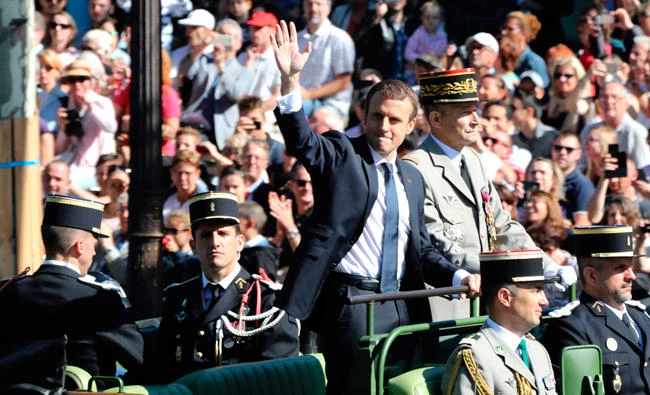
During the parade, Macron rode down the Champs-Elysees avenue in an open-topped military command vehicle standing side-by-side with a grim-faced De Villiers as Trump watched.
The deep cuts to the defense budget have angered the military because Macron has made a point of showing support for the military since coming to power in May.
In his first foreign visit after taking office, he visited French troops engaged in counter-terrorism operations in the West African country of Mali.
The cuts are part of €4.5 billion to public spending that his centrist government has promised to reduce the budget deficit.
Macron pledged during his election campaign to boost defense spending to 2 percent of GDP by 2025, in line with NATO targets.
Marine Le Pen, the far-right leader whom Macron beat in the presidential runoff, said the French military had lost “a man of huge value” and claimed the resignation showed “the very serious abuses and worrying limits” of the president’s leadership.
Damien Abad, a member of the opposition Republicans who sits on the parliamentary defense committee, tweeted that Macron’s “excessive authoritarianism led to the resignation.”
Nuclear-armed France and Britain are the biggest military powers in the EU.
French forces are engaged in military strikes against Daesh terrorists in Syria and Iraq and 4,000 French soldiers are involved in efforts to stop the spread of extremism in African countries including Mali, Burkina Faso and Chad.
Soldiers also patrol the streets of French cities under a state of emergency introduced after a series of terror attacks that have killed more than 230 people since 2015.
The bitter row between Macron and Gen. Pierre De Villiers blew up last week when the chief of staff told a parliamentary committee he would not allow the armed forces to be “screwed” by the government’s plans to slash €850 million ($980 million) from his budget.
Macron, 39, slapped down the 60-year-old general, telling army top brass at their annual summer party “I am the boss” and saying he deeply regretted that the budget row had been dragged into the “public sphere.”
In a newspaper interview at the weekend, Macron added that if there was a difference of opinion, “it is the chief of the defense staff who will change his position.”
De Villiers said in his resignation statement he felt he had no choice but to stand down because “I no longer feel able to ensure the sustainability of the model of the armed forces that I think is necessary to guarantee the protection of France and the French people.”
The five-star general, who served in Kosovo and Afghanistan and is widely liked by the rank and file, said throughout his career, he had believed it was his duty to tell politicians “of my reservations.”
Seen as one of the finest officers of his generation, he had prided himself on looking out for his troops.
The row has provoked a debate about whether Macron had humiliated his military chief or whether he had no choice but to exert his authority just two months into his presidency.
A former head of the French Air Force, Gen. Vincent Lanata, told L’Express news weekly on Tuesday he was “very shocked” by Macron’s “rant” at De Villiers.
The crisis was exacerbated by its timing as it emerged in the week of the July 14 Bastille Day military parade, where US President Donald Trump was the guest of honor.
During the parade, Macron rode down the Champs-Elysees avenue in an open-topped military command vehicle standing side-by-side with a grim-faced De Villiers as Trump watched.
The deep cuts to the defense budget have angered the military because Macron has made a point of showing support for the military since coming to power in May.
In his first foreign visit after taking office, he visited French troops engaged in counter-terrorism operations in the West African country of Mali.
The cuts are part of €4.5 billion to public spending that his centrist government has promised to reduce the budget deficit.
Macron pledged during his election campaign to boost defense spending to 2 percent of GDP by 2025, in line with NATO targets.
Marine Le Pen, the far-right leader whom Macron beat in the presidential runoff, said the French military had lost “a man of huge value” and claimed the resignation showed “the very serious abuses and worrying limits” of the president’s leadership.
Damien Abad, a member of the opposition Republicans who sits on the parliamentary defense committee, tweeted that Macron’s “excessive authoritarianism led to the resignation.”
Nuclear-armed France and Britain are the biggest military powers in the EU.
French forces are engaged in military strikes against Daesh terrorists in Syria and Iraq and 4,000 French soldiers are involved in efforts to stop the spread of extremism in African countries including Mali, Burkina Faso and Chad.
Soldiers also patrol the streets of French cities under a state of emergency introduced after a series of terror attacks that have killed more than 230 people since 2015.