- Pegon Arabic script was widely used across the Indonesian Archipelago from the 15th century
- Faisal Kamandobat’s 30m manuscript is centerpiece of SEA Junction exhibition in Bangkok
DUBAI: When Dutch colonizers phased out Indonesia’s traditional Arabic-based writing system, they replaced it with Latin letters that served their administration. Centuries later, Indonesian artist Faisal Kamandobat is reviving that lost script to retell the colonial past.
The Pegon Arabic script was widely used to write different languages across the Indonesian Archipelago from the era of the Banten Sultanate in the 15th century. It served Islamic religious scholarship, government and trade, literature, and everyday writing of elites and ordinary people alike.
This writing tradition was gradually erased by the Dutch, who colonized the archipelago from the early 17th century to the 1940s, and, later, by Indonesia’s modern governments, which followed suit.
“The Dutch colonial government and the Indonesian state labeled anyone who could not write in Latin script as ‘illiterate,’ ‘traditional’ and ‘backward,’” Kamandobat told Arab News.
“Yet Latin is not a script connected to nature and ancestral rituals, but an instrument of modernization for business administration, politics and orientalism. Latinization of knowledge was an effort to sever the community from its customs, religion and ecology. After that, the state and corporations could more easily seize land and resources.”
His new artwork, “Negotiating Danger,” which is now the centerpiece of the SEA Junction exhibition in Bangkok, narrates just that.
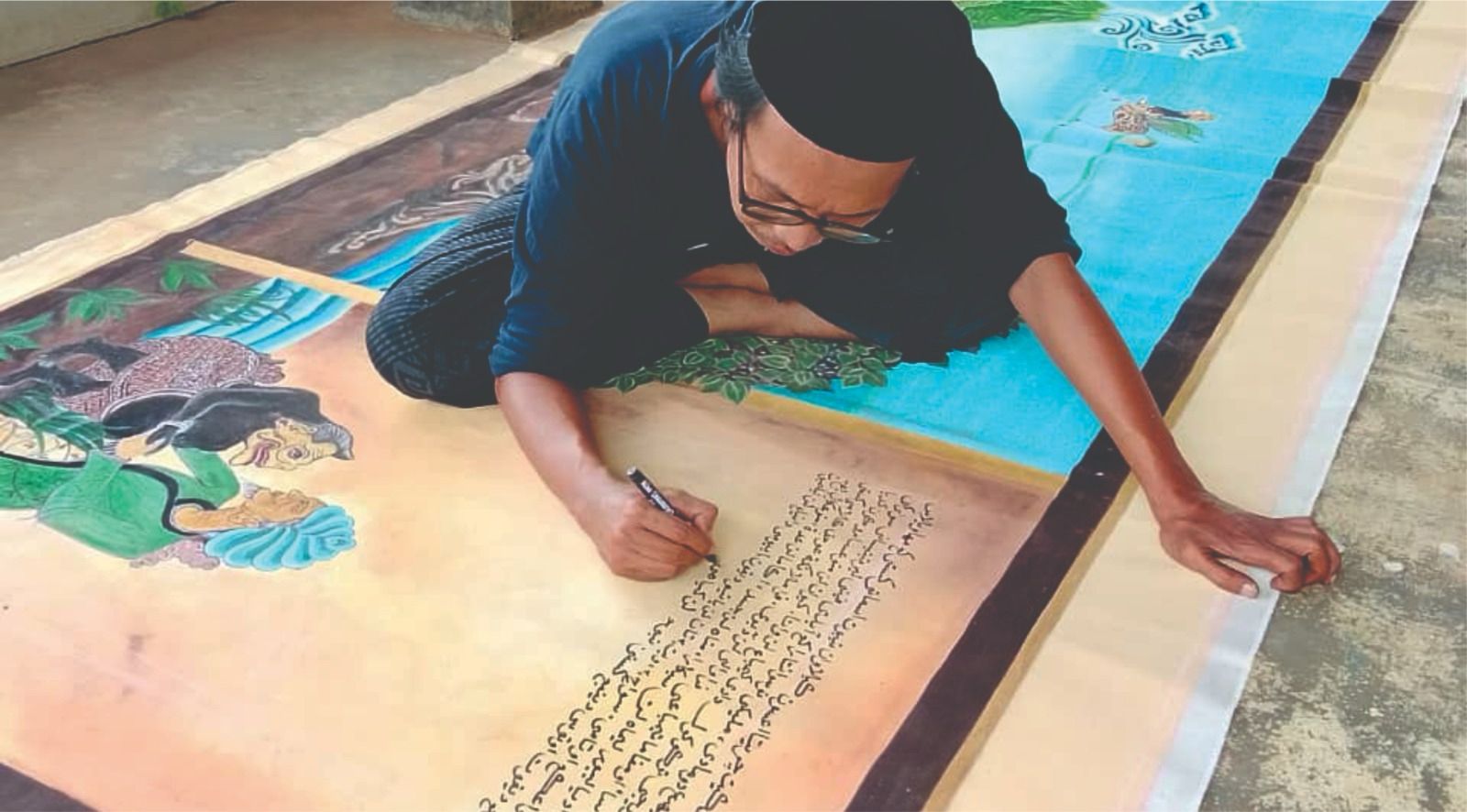
A 30-meter-long manuscript in eight scrolls, it begins with a story and picture of harmony, where humans, nature and legendary beings from Islamic and local cosmology — the prophet-saint Khidr, the Javanese goddess of rice Dewi Sri and Ratu Kidul, ruler of the seas — coexist in peace.
This order collapses with the arrival of European colonialism, represented by Leviathan — a Western metaphor for the all-powerful modern state — Poseidon, the Greek god symbolizing maritime conquest, and the Goblin, which is associated with greed. In further scrolls, their presence develops into colonial domination, capitalism and militarism that brought to the region the extraction of its resources and people, and the destruction of local knowledge and rules.
The impacts of these continued through systems rooted in competition and conflict over the control of natural and human resources.
Today, they are visible not only in Indonesia, but across the whole Southeast Asia and beyond.
“We are seeing the exploitation of natural resources and the consequences of this competition and exploitation — the use of natural resources in a very unsustainable way to the point that even the human race is affected in the sense of the disasters that we are seeing multiplying all over the world,” said Prof. Rosalia Sciortino, the exhibition’s curator and development sociologist from Mahidol University in Bangkok.
“In this artwork, it’s very clear that first the tradition of the ideology of colonialism and now capitalism and corporatism — the use of companies supported by the state, often by military regimes — is what is provoking all these disasters and impacting the lives of the people.”
What was once colonization has now been rebranded but remains based on the same processes. Prof. Sciortino gave as an example one of the last scrolls, which depicts a factory featuring Indonesian and European supervisors, indicating corporate interests and collusion, and two spirits, which in Javanese mythology can stand for theft, greed or corruption.
“Then there is also a very small design of a drone, which indicates surveillance. Now, in this contemporary area, there is also the issue of surveillance ... and the fact that a small group of people controls this,” she said.
“There are a lot of groups that are trying to raise awareness, but maybe this is a special way of doing so; through mythological characters and using ideals that are culturally strong to send a message that is universal.”