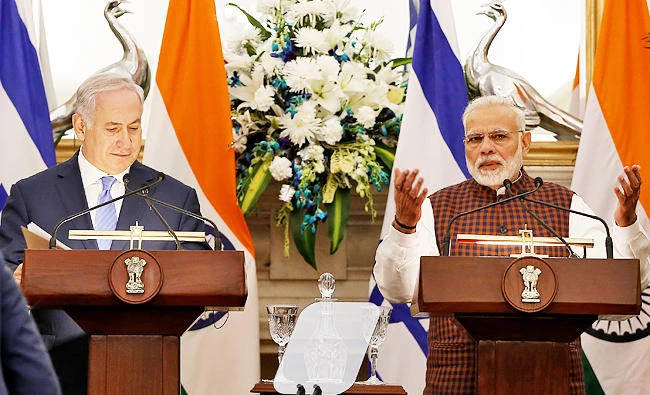
NEW DELHI: India and Israel signed a number of agreements to take the relationship to a new level in the next 25 years.
Indian Prime Minister Narendra Modi and Israeli counterpart Benjamin Netanyahu held delegation-level talks in New Delhi on Monday and inked nine agreements including on cybersecurity, agriculture, water, research and development, homeland security, trade and people-to-people contact.
“In the next 25 years the two respective countries should strive to raise bilateral cooperation in diverse sectors to a qualitatively new level in consonance with our strategic partnership,” the joint statement issued after the meeting said.
There was a visible camaraderie between the two leaders who were meeting each other after a gap of six months with Netanyahu addressing the Indian prime minister by his first name.
In a joint press conference after the official level talks, Modi said that “thriving two-way trade and investment is an integral part of our vision for a strong partnership. Prime Minister Netanyahu and I agreed on the need to do more in this direction.”
The Israeli prime minister called Modi “a revolutionary leader” and said that “Jews in India have never witnessed anti-Semitism like in some other countries; this is a tribute to India’s great civilization, tolerance and democracy. My wife and I are very happy that we are going to Bollywood.”
The statement also underlined the importance of “joint ventures” in the defense sector under the “Make in India” initiative and set the direction for developing more business models and partnerships for “joint ventures and joint manufacturing, including transfer of technology as well as joint research and development in defense and security fields.”
“The wide range of agreement shows that Israel is determined to strengthen ties with India, the largest democracy in the world and one of the emerging voices on the world stage, isolated as it is in the world due to its policies vis-a-vis the Palestinians,” said Dr. Sujata Ashwarya, an assistant professor in the Center for West Asia Studies in Jamia Milia Islamia university.
“No doubt there is an ideological tinge to the camaraderie between the two leaders but it is hard reciprocal interests that bind the governments of both the countries,” Ashwarya told Arab News.
Dr. Zakir Hussain, of the Indian Council of World Affairs (ICWA), a New Delhi-based think tank, said that “the wide-ranging agreement” showed that “we have reached a second level of our relations, we don’t need to explore areas. Areas are already explored. We want to add values to our relations in terms of mutual benefit.”
Hussain said that “Israel wants India to change its position on Palestine and by deepening political and economic engagement with New Delhi it wants to mold India’s stand vis-a-vis Palestine.”
He said that “India has historically a consistent policy toward Palestine.
“Next month Modi is visiting Oman, UAE and Palestine. It sends a message that New Delhi wants to strike a balance in its ties with Tel Aviv and the larger Arab world,” Hussain said.
Ashwarya said that India’s foreign policy had demonstrated strategic flexibility for a long time in dealing with countries that had antagonistic relations with each other and was able to process different interests in different bilateral relations. “Nation-states pursue interests and India and Israel are doing just that, let’s look at their burgeoning ties that way.”
She said that “for India it is important to balance its geostrategic ties with Iran and at the same time protect its interests in Israel.”
Indian Prime Minister Narendra Modi and Israeli counterpart Benjamin Netanyahu held delegation-level talks in New Delhi on Monday and inked nine agreements including on cybersecurity, agriculture, water, research and development, homeland security, trade and people-to-people contact.
“In the next 25 years the two respective countries should strive to raise bilateral cooperation in diverse sectors to a qualitatively new level in consonance with our strategic partnership,” the joint statement issued after the meeting said.
There was a visible camaraderie between the two leaders who were meeting each other after a gap of six months with Netanyahu addressing the Indian prime minister by his first name.
In a joint press conference after the official level talks, Modi said that “thriving two-way trade and investment is an integral part of our vision for a strong partnership. Prime Minister Netanyahu and I agreed on the need to do more in this direction.”
The Israeli prime minister called Modi “a revolutionary leader” and said that “Jews in India have never witnessed anti-Semitism like in some other countries; this is a tribute to India’s great civilization, tolerance and democracy. My wife and I are very happy that we are going to Bollywood.”
The statement also underlined the importance of “joint ventures” in the defense sector under the “Make in India” initiative and set the direction for developing more business models and partnerships for “joint ventures and joint manufacturing, including transfer of technology as well as joint research and development in defense and security fields.”
“The wide range of agreement shows that Israel is determined to strengthen ties with India, the largest democracy in the world and one of the emerging voices on the world stage, isolated as it is in the world due to its policies vis-a-vis the Palestinians,” said Dr. Sujata Ashwarya, an assistant professor in the Center for West Asia Studies in Jamia Milia Islamia university.
“No doubt there is an ideological tinge to the camaraderie between the two leaders but it is hard reciprocal interests that bind the governments of both the countries,” Ashwarya told Arab News.
Dr. Zakir Hussain, of the Indian Council of World Affairs (ICWA), a New Delhi-based think tank, said that “the wide-ranging agreement” showed that “we have reached a second level of our relations, we don’t need to explore areas. Areas are already explored. We want to add values to our relations in terms of mutual benefit.”
Hussain said that “Israel wants India to change its position on Palestine and by deepening political and economic engagement with New Delhi it wants to mold India’s stand vis-a-vis Palestine.”
He said that “India has historically a consistent policy toward Palestine.
“Next month Modi is visiting Oman, UAE and Palestine. It sends a message that New Delhi wants to strike a balance in its ties with Tel Aviv and the larger Arab world,” Hussain said.
Ashwarya said that India’s foreign policy had demonstrated strategic flexibility for a long time in dealing with countries that had antagonistic relations with each other and was able to process different interests in different bilateral relations. “Nation-states pursue interests and India and Israel are doing just that, let’s look at their burgeoning ties that way.”
She said that “for India it is important to balance its geostrategic ties with Iran and at the same time protect its interests in Israel.”