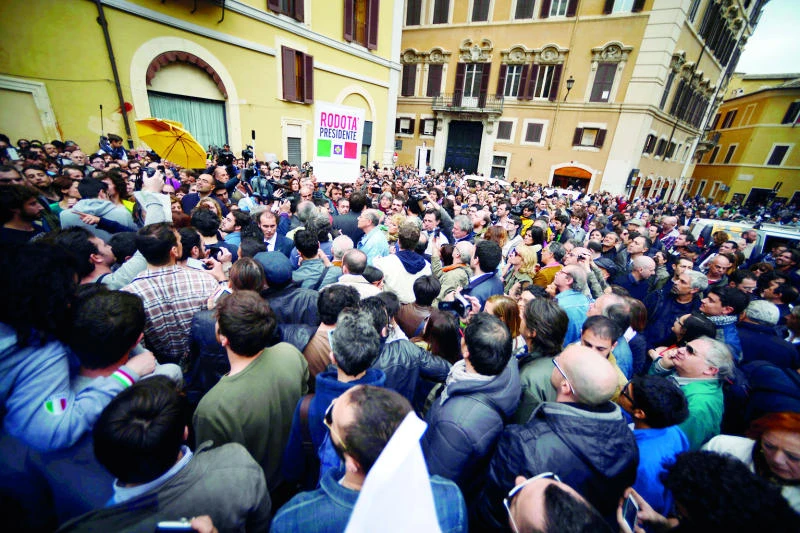
ROME: Italian President Giorgio Napolitano agreed yesterday to serve a second term after a divided Parliament failed for a fifth time to elect his successor and risked prolonged political paralysis.
The presidency is a largely ceremonial position but is crucial at times of political instability like the present, when the president plays a major role in forming a government and has the power to dissolve Parliament.
“I feel obliged to offer my availability as requested,” the 87-year-old Napolitano said in a statement. “I cannot shun my responsibility toward the nation.”
Napolitano had ruled out continuing in office on several occasions, citing his advanced age and the fact that no president has ever before served two terms. But he said he had changed his mind in response to appeals by coalition leaders who saw his candidacy as the only way to break the deadlock in Parliament.
With the apparent support of the main center-left and center-right blocs it would be a huge surprise if Napolitano did not win the votes required for election.
He would be formally elected for a full seven-year term but most commentators believe that once the president crisis is resolved, he would probably resign within a year.
Earlier in the day center-left and center-right leaders Pier Luigi Bersani and Silvio Berlusconi and caretaker Premier Mario Monti who heads a centrist group, all went to Napolitano’s palace to ask him to carry on. Napolitano, whose term ends on May 15, already failed to broker a solution to the political deadlock that has dragged on since an inconclusive February election.
However, if re-elected he would have the power to dissolve Parliament, which he did not have in the final months of his current term. In the fifth vote of the 1,007 parliamentarians and regional representatives, most of the electors cast blank ballots after the parties failed to agree on a mutually acceptable candidate.
The candidate who received most votes, left-wing academic Stefano Rodota, backed by the anti-establishment 5-Star Movement, fell far short of the 504 required to win.
Two rounds of voting are held each day. The country’s political chaos deepened on Friday after a split over candidates flung the main center-left alliance into disarray and its leader Bersani said he would resign as soon as a new president had been elected.
Scores of rebels in his Democratic Party (PD) sabotaged two separate candidates he had proposed for the presidential elections. The PD’s president, Rosy Bindi, also resigned.
“The leadership of the Democratic Party is tumbling down,” wrote political commentator Massimo Franco in an editorial in Corriere della Sera. “This is the end of an era.” The transformation in the fortunes of Bersani, who three months ago seemed the likely next prime minister, underlined the uncertainty over how a deeply divided political class can implement much-needed reforms to tackle an economy that has stagnated for the last 20 years.
There will now be a leadership battle in the PD, founded to unite a range of smaller leftist and centrist parties in 2007.
Italian president to run for 2nd term