Custodian of the Two Holy Mosques King Abdullah sent a cable of condolences to Pakistani President Mamnoon Hussain over the deaths and devastations caused by the earthquake that hit south west of Pakistan Tuesday afternoon.
The king expressed deep sorrow on his behalf and on behalf of the Saudi people. The king also wished speedy recovery for those who were injured in the disaster.
Crown Prince Salman, deputy premier and minister of defense, also sent a message of condolences to Pakistan president, the Saudi Press Agency reported on Thursday.
Meanwhile, militants fired rockets at a helicoper carrying the head of Pakistan’s disaster relief agency in the country’s quake-hit southwest Thursday, military officials said, but no damage was done, according to AFP.
The helicopter with Maj. Gen. Muhammad Saeed Aleem, chairman of the National Disaster Management Authority, on board was flying over Awaran district in Baluchistan province, the area worst hit by Tuesday’s 7.7-magnitude quake.
“Two rockets were fired on the helicopter and the target was missed,” a military official in the provincial capital Quetta told AFP.
“The area is rife with insurgency and has presence of Baluchistan Liberation Front insurgents.”
Another military official confirmed the attack and said everyone in the helicopter was safe.
Baluchistan, Pakistan’s largest but least developed province, has been struggling with a violent separatist insurgency since 2004.
The 7.7-magnitude quake which hit on Tuesday has killed nearly 350 people and made more than 100,000 homeless.
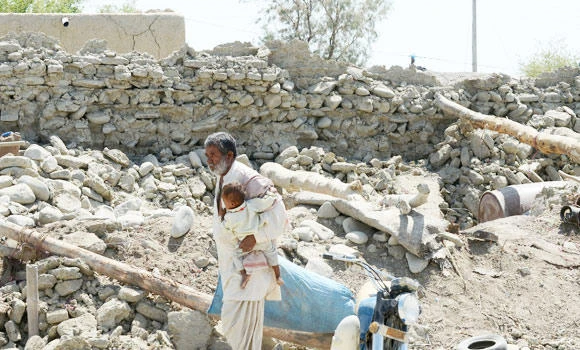
Survivors built makeshift shelters with sticks and bedsheets after their mud houses were flattened in an earthquake that killed 348 people in southwestern Pakistan and pushed a new island up out of the Arabian Sea.
While waiting for help to reach remote villages, hungry people dug through the rubble to find food. And the country’s poorest province struggled with a dearth of medical supplies, hospitals and other aid.
Tuesday’s quake flattened wide swathes of Awaran district, where it was centered, leaving much of the population homeless.
Almost all of the 300 mud-brick homes in the village of Dalbadi were destroyed. Noor Ahmad said he was working when the quake struck and rushed home to find his house leveled and his wife and son dead.
“I’m broken,” he said. “I have lost my family.”
The spokesman for the Baluchistan provincial government, Jan Mohammad Bulaidi, said Thursday that the death toll had climbed to 348 and that another 552 people had been injured.
Doctors in the village treated some of the injured, but due to a scarcity of medicine and staff, they were mostly seen comforting residents.
The remoteness of the area and the lack of infrastructure hampered relief efforts. Awaran district is one of the poorest in the country’s most impoverished province. Just getting to victims was challenging in a region with almost no roads where many people use four-wheel-drive vehicles and camels to traverse the rough terrain. “We need more tents, more medicine and more food,” said Bulaidi.
Associated Press images from the village of Kaich showed the devastation. Houses made mostly of mud and handmade bricks had collapsed. Walls and roofs caved in, and people’s possessions were scattered on the ground. A few goats roamed through the ruins.
The Pakistani military said it had rushed almost 1,000 troops to the area overnight and was sending helicopters as well. A convoy of 60 Pakistani army trucks left the port city of Karachi early Wednesday with supplies.
Pakistani forces have evacuated more than 170 people from various villages around Awaran to the district hospital, the military said. Others were evacuated to Karachi.
One survivor interviewed in his Karachi hospital bed said he was sleeping when the quake struck.
“I don’t know who brought me from Awaran to here in Karachi, but I feel back pain and severe pain in my whole body,” he said.
Jan said he didn’t know what happened to the man’s family. He was trying to contact relatives.
Local officials said they were sending doctors, food and 1,000 tents for people who had nowhere to sleep. The efforts were complicated by strong aftershocks.
Baluchistan is Pakistan’s largest province but also the least populated. Medical facilities are few and often poorly stocked with supplies and qualified personnel. Awaran district has about 300,000 residents spread out over 29,000 sq km.
The local economy consists mostly of smuggling fuel from Iran or harvesting dates.
The area where the quake struck is at the center of an insurgency that Baluch separatists have been waging against the Pakistani government for years. The separatists regularly attack Pakistani troops and symbols of the state, such as infrastructure projects.
It’s also prone to earthquakes. A magnitude 7.8 quake centered just across the border in Iran killed at least 35 people in Pakistan last April.
Tuesday’s shaking was so violent it drove up mud and earth from the seafloor to create an island off the Pakistani coast.
A Pakistani Navy team reached the island by midday Wednesday. Navy geologist Mohammed Danish told the country’s Geo Television that the mass was a little wider than a tennis court and slightly shorter than a football field.
The director of the National Seismic Monitoring Center confirmed that the mass was created by the quake and said scientists were trying to determine how it happened. Zahid Rafi said such masses are sometimes created by the movement of gases locked in the earth that push mud to the surface.
“That big shock beneath the earth causes a lot of disturbance,” he said.
He said these types of islands can remain for a long time or eventually subside back into the ocean, depending on their makeup.
He warned residents not to visit the island because it was emitting dangerous gases.
But dozens of people went anyway, including the deputy commissioner of Gwadar district, Tufail Baloch.
Water bubbled along the edges of the island. The land was stable but the air smelled of gas that caught fire when people lit cigarettes, Baloch said.
Dead fish floated on the water’s surface while residents visited the island and took stones as souvenirs, he added.
King sends condolences to Pak president over quake deaths