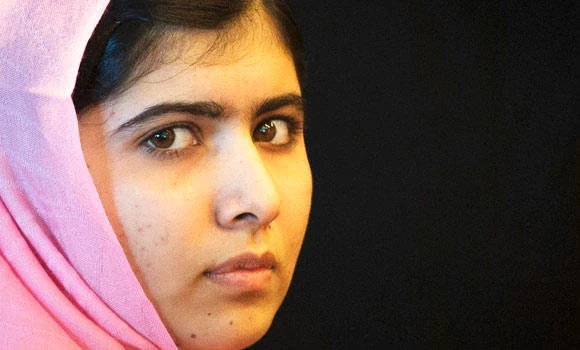
LONDON: Malala Yousufzai, the Pakistani schoolgirl shot by the Taleban last year for campaigning for girls’ education, said Monday she hoped to become a politician to “change the future of my country.”
The 16-year-old, whose continued fight for all children to go to school has made her a favorite for the Nobel Peace Prize this week, also backed dialogue with the Taleban, although she said this was an issue for the government.
“I will be a politician in my future. I want to change the future of my country and I want to make education compulsory,” Malala said in a BBC interview.
She added: “The best way to solve problem and to fight against war is through dialogue, and is through peaceful way.
“But for me the best way to fight against terrorism and extremism is a simple thing — educate the next generation.” She added that issues of terrorism are “not an issue for me, that’s the job of the government.. and that’s also the job of America.” Malala dismissed the continued threats against her life and repeated her desire to return to Pakistan from Britain, where she was flown for treatment after the attack in October and where she now goes to school.
“The bad thing in our society and in our country is that you always wait for someone else to come,” Malala said.
“If I’m saying that there is no-one who is doing anything for education, if I say there is no electricity, there is no natural gas, the schools are being blasted, and I’m saying no-one is doing this, why don’t I go for it, why don’t I do this? “I believe that I will achieve this goal because Allah is with me, God is with me and He saved my life.”
Malala admitted Britain had been a culture shock, “especially for my mother because we had never seen that women would be that much free — they would go to any market, they would be going alone with no men, no brothers and fathers.” She said: “I’m not becoming Western, I’m still following my own culture, the Pashtun culture.”
In an excerpt in The Sunday Times, she describes riding in a school van with her girlfriends when it was stopped by two men, including the gunman who shot Malala in the left eye socket at close range.
“I woke up on Oct. 16, a week after the shooting,” she writes. “The first thing I thought was, ‘Thank God I’m not dead.’ But I had no idea where I was. I knew I was not in my homeland. The nurses and doctors were speaking English though they all seemed to be from different countries.”
She gradually found out that she had been taken from Pakistan to Birmingham, England, for specialist treatment. The book excerpt describes how she gradually regained her sight and her voice and was reunited with her parents.
Malala also describes her amazement at finding out that some 8,000 people had sent messages of support to the hospital.
“Rehanna, the Muslim chaplain, said millions of people and children around the world had supported me and prayed for me,” Malala writes. “Then I realized that people had spared my life. I had been spared for a reason. I realized that what the Taleban had done was make my campaign global.”
Threatened again
The Pakistani Taleban on Monday said Malala Yousafzai had “no courage” and vowed to attack her again if they got the chance.
But Shahidullah Shahid, spokesman for the main Tehreek-e-Taleban Pakistan (TTP) umbrella group, slammed Malala and said they would try again to kill her.
“She is not a brave girl and has no courage. We will target her again and attack whenever we have a chance,” Shahid said.
While she has been feted by celebrities and world leaders across the West, in deeply conservative Swat Malala’s achievements are eyed with suspicion by some.
Malala calls for talks with Taleban