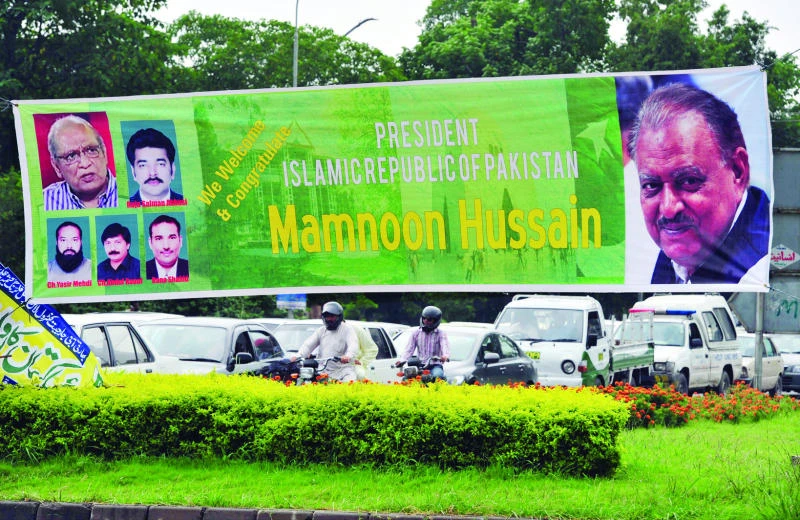
ISLAMABAD: Pakistan’s new President Mamnoon Hussain took office on Monday, presiding over a government battling to overcome a Taleban insurgency, resolve an energy crisis and repair the economy.
A respected businessman from the financial capital of Karachi but with no political powerbase of his own, Hussain is Pakistan’s 12th president and a ceremonial head of state.
His time in office should cement Pakistan’s transition back to a strong prime minister and parliamentary democracy after his predecessor reversed amendments made by military rulers.
Hussain was sworn in by chief justice Iftikhar Muhammad Chaudhry in a short ceremony after political leaders gathered together for cross-party talks on how to tackle growing insecurity.
Prime Minister Nawaz Sharif and outgoing president Asif Ali Zardari watched as Hussain took oath, wearing a black hat in the style of Pakistan’s founding father Muhammad Ali Jinnah.
The 73-year-old Hussain was elected on July 30 by members of the four provincial assemblies and the federal parliament.
A close ally of Sharif, Hussain’s low-key persona and lack of personal power will put him in stark contrast to Zardari.
The widower of former prime minister Benazir Bhutto presided over the only civilian government in Pakistan to complete a full term in office and hand over to another at the ballot box.
Zardari’s Pakistan People’s Party (PPP) suffered a humiliating electoral defeat to the Pakistan Muslim League-N (PML-N) in May when Sharif was elected for a record third term as premier.
Hussain is a former president of the Karachi Chamber of Commerce and was briefly governor of the southern province Sindh until Sharif’s second administration was deposed by the military.
A conference of Pakistani political parties has decided to endorse the government’s efforts to negotiate with militants in the tribal regions bordering Afghanistan who have been trying to overthrow the Pakistani state.
Political leaders said in a statement Monday that they were authorizing the government to do what was necessary to bring about negotiations.
The announcement came after a meeting of politicians from the major political parties at the prime minister’s residence to discuss the security situation.
Prime Minister Nawaz Sharif came into office in June saying he supported talks instead of military operations to bring about peace.
Monday’s announcement gives him the political backing he wanted to try to negotiate with the militants. But the militants have said repeatedly that they have no interest in talking to his government.
Mamnoon Hussain takes helm