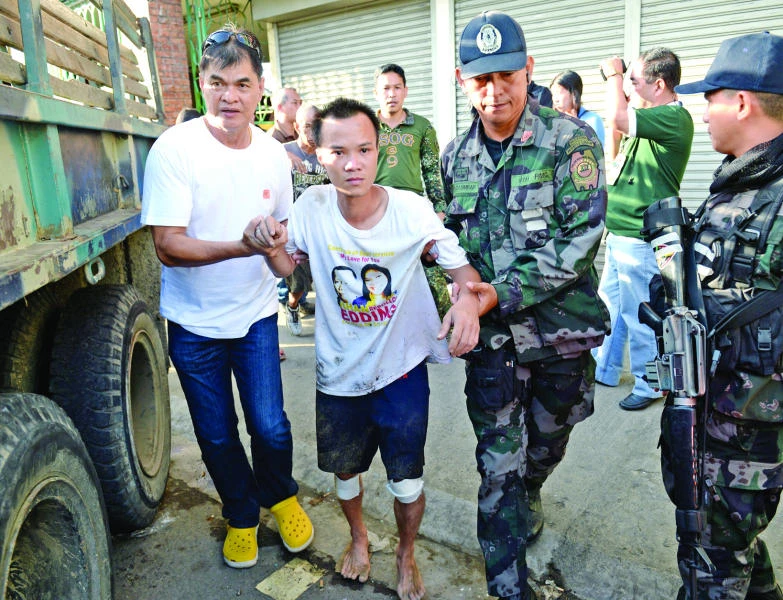
ZAMBOANGA, Philippines: More than a hundred people who were held hostage by rebels waging deadly street battles with Philippine troops escaped Tuesday amid a military offensive in which dozens of guerrillas were killed.
In a related incident, a Philippine police chief who was reported abducted Tuesday by the rebels has emerged free hours later after convincing his captors to surrender in a twist to a nine-day hostage standoff in the south of the country, officials said.
Interior Secretary Mar Roxas and police officials later told a news conference that Senior Superintendent Jose Chiquito Malayo and three of his men were taken at gunpoint while trying to persuade some Moro National Liberation Front (MNLF) rebels to surrender in fighting near Zamboanga city.
“While trying to convince them, he was taken into custody or held hostage but he kept on convincing them until he succeeded,” Roxas told reporters.
The rebels said they had come from a nearby island to join a peaceful protest by their group in Zamboanga but withdrew after firefights erupted between government troops and their comrades, Roxas said, adding police would investigate their claims.
“The important thing here is he (Malayo) was able to enact the surrender,” military spokesman Lt. Col. Ramon Zagala said.
The surrender of about 20 rebels comes as government troops intensify an offensive to end the standoff that began Sept. 9 when the troops foiled a suspected plan by a larger group of rebels to take control of Zamboanga, a major port of nearly 1 million people about 860 km south of Manila.
The military says it has recaptured 70 percent of the coastal areas occupied by the rebels and rescued more than 100 hostages.
About 64 hostages were freed or escaped during military operations early Tuesday, followed by another 14 who walked to freedom in separate batches. That brought to 116 the number of those rescued in the last 18 hours, Zagala said.
He said more than 100 Moro National Liberation Front rebels were still holding hostages in the remaining pockets they control in five coastal villages in Zamboanga.
Nearly 82,000 residents have fled the fighting into several emergency shelters, including the city’s main sports complex.
Ninety-nine people have died and 90,000 residents displaced since the standoff in the southern city of Zamboanga began on Monday last week, when hundreds of Moro National Liberation Front (MNLF) gunmen invaded in a bid to derail peace talks.
Hundreds of other civilians had remained trapped as the rebels sought shelter from a military assault in the city, with some of the residents used as hostages or human shields.
After a relentless military offensive involving helicopter rocket attacks and intense street fighting, 149 people escaped on Monday night and Tuesday morning from the MNLF, authorities said.
The shell-shocked men, women and children were tearfully reunited away from the frontlines with their relatives, who had waited in anguish for days.
“I couldn’t sleep, I couldn’t eat, all I thought about was my little boy and my family,” said a 28-year-old hotel employee as he and his rescued family members embraced tightly.
The man, who did not want his name published for security reasons left Zamboanga three months ago with his wife to work in the United States but returned when they learnt their relatives had been taken hostage.
Military spokesman Lt. Col. Ramon Zagala said the rebels had been swept out of 70 percent of neighborhoods they had initially controlled and reduced to a few dozen fighters, down from an estimated 200 when the conflict began.
“They (the rebels) have nearly run out of bullets. They are practically defeated,” Zagala told AFP.
In one of the biggest victories, Zagala said 123 hostages had been freed in a battle with rebels on Tuesday morning that left three soldiers dead.
Thirty rebels had been killed over the past 24 hours, according to Zagala. This brought the total number of MNLF fatalities to 86, with nine security forces and four civilians also killed.
But Zagala acknowledged that the rebels remained a threat, as they hid in homes and possibly continued to hold civilians as hostages.
“This is not yet over... there are still pockets of resistance,” he said, noting that the rebels were also occupying key areas in which they could shoot down at advancing troops.
In one confusing distraction to the conflict, the national police spokesman reported that the city’s police chief Senior Superintendent Chiquito Malayo was kidnapped on Tuesday morning.
However Interior Secretary Mar Roxas later sent a text message to the media saying Malayo had returned from MNLF territory having convinced 23 rebels to “come into the fold of the law”.
The national police spokesman who initially reported the alleged abduction, Senior Superintendent Reuben Sindac, was not available for immediate comment to clarify.
Muslim rebels have been fighting since the 1970s for an independent or autonomous homeland the south of the Philippines. An estimated 150,000 people have died in the conflict.
President Benigno Aquino has described the autonomous region established under the 1996 pact with the MNLF as a “failed experiment,” largely because the southern Philippines has continued to endure dire poverty and corruption.
Under the envisaged new peace deal, a new autonomous region would replace the MNLF-brokered one.
Many hostages escape amid army assaults in Philippines