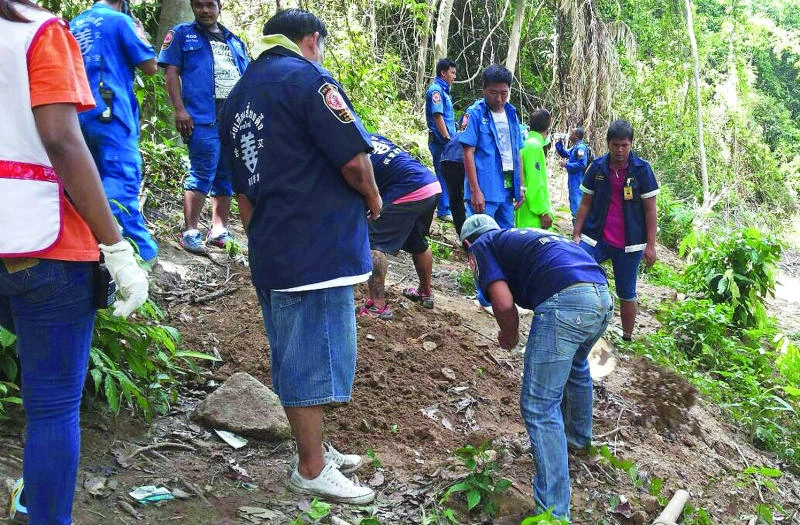
HAT YAI/BANGKOK: Authorities in Thailand uncovered a mass grave in an abandoned jungle camp on Friday believed to contain the remains of migrants from Myanmar and Bangladesh, a grisly find in a region notorious for people-smuggling routes.
Dozens of shallow graves with at least one corpse in an isolated mountain shelter are believed to be a trafficking camp for ethnic Rohingya Muslims fleeing Myanmar.
The discovery was made at a remote camp in Sadao district, in Songkhla province bordering Malaysia, and comes as Thailand’s junta cracks down on human trafficking following accusations that officials have been complicit in the trade.
The grim discovery was likely to revive discussion about human trafficking in Thailand, a known transiting route for ethnic Rohingya, one of the world’s most persecuted minorities.
Acting on a tip from local villagers, authorities sent teams of police and rescuers into the mountains of Padang Besar sub-district in southern Thailand’s Songkla province. Reaching the camp on foot, they found a shelter with at least one corpse, one man who was alive but very weak and what appeared to be several other corpses, police Col. Weerasant Tharnpiem said.
Weerasant, the commander of Padang Besar police station, initially told The Associated Press that 32 bodies were found but later said he was ordered not to speak to the media further.
The border area with Malaysia is notorious for its network of secret camps where smuggled migrants are held, usually against their will until relatives pay up hefty ransoms.
“There are 32 graves, four bodies have now been exhumed and are on their way... to hospital for an autopsy,” Sathit Thamsuwan, a rescue worker who was at the scene soon after the site was found, told AFP, saying it was unclear how they had died.
“The bodies were all decayed,” he said, adding a single emaciated man from Bangladesh survived and was being treated at a hospital in nearby Padang Besar.
National police chief General Somyot Poompanmoung described the site as a virtual “prison camp” where migrants were held in makeshift bamboo cells.
“There are 32 places that look like graves and whether there is one body or several bodies in those graves, we will we have to wait and see,” he said.
He said the smugglers were believed to have abandoned the sick man when they moved Rohingya migrants across the border into Malaysia two days ago.
Local media said the camp and its lone survivor were stumbled upon by villagers looking for mushrooms.
The hospital confirmed the Bangladeshi man had survived and said he was in a stable condition.
A senior official from Sadao said exhumations had now stopped pending the arrival of forensic teams.
Tens of thousands of migrants from Myanmar, mainly from the Rohingya Muslim minority but also increasingly from Bangladesh, make the dangerous sea crossing to southern Thailand, a well-worn trafficking route often on the way south to Malaysia and beyond.
Thousands of Rohingya, described by the UN as one of the world’s most persecuted minorities, have fled deadly communal unrest in western Myanmar’s Rakhine state since 2012.
Chris Lewa, from the Arakan Project which monitors the smuggling routes, said survivors of the jungle camps often described horrific conditions as they waited for relatives to pay ransoms.
“If police find a camp and start digging you can bet they will find graves,” she told AFP.
Mass ‘prison camp’ grave found in Thailand