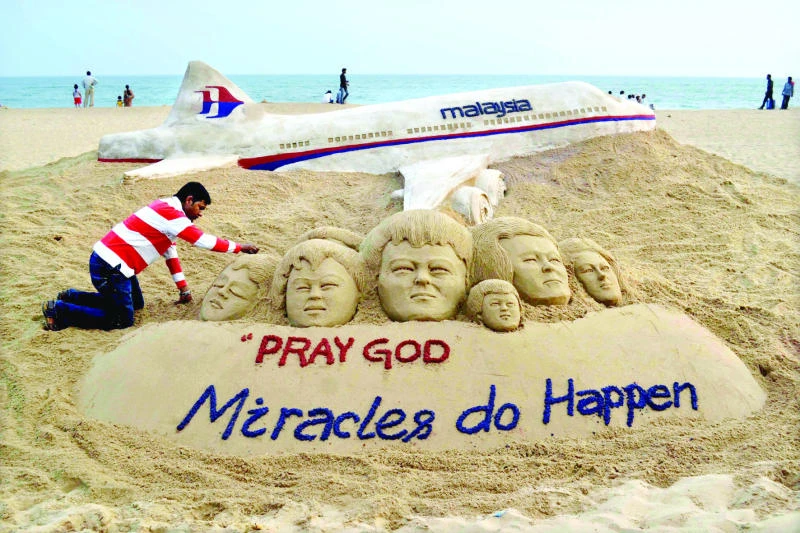
KUALA LUMPUR: International intelligence agencies joined the investigation Sunday into two passengers who boarded the missing Boeing 777 jetliner with stolen passports, as Malaysian authorities said radar images showed the plane may have turned back before vanishing.
More than a day and half after Malaysia Airlines Flight MH370 went missing, the final minutes before it disappeared remained a mystery. The plane, which was carrying 239 people, lost contact with ground controllers somewhere between Malaysia and Vietnam after leaving Kuala Lumpur early Saturday morning for Beijing.
The missing plane apparently fell from the sky at cruising altitude in fine weather, and the pilots were either unable or had no time to send a distress signal — unusual circumstances under which a modern jetliner operated by a professional airline would crash.
Malaysia’s air force chief, Rodzali Daud, said radar indicated that the plane may have turned back, but did not give further details on which direction it went or how far it veered off course.
“We are trying to make sense of this,” Daud said at a news conference. “The military radar indicated that the aircraft may have made a turn back, and in some parts this was corroborated by civilian radar.”
Malaysia Airlines Chief Executive Ahmad Jauhari Yahya said pilots are supposed to inform the airline and traffic control authorities if the plane does a U-turn. “From what we have, there was no such distress signal or distress call per se, so we are equally puzzled,” he said.
Authorities were checking on the identities of the two passengers who boarded the plane with stolen passports. On Saturday, the foreign ministries in Italy and Austria said the names of two citizens listed on the flight’s manifest matched the names on two passports reported stolen in Thailand.
“I can confirm that we have the visuals of these two people on CCTV,” Malaysian Transport Minister Hishammuddin Hussein said at a news conference late Sunday, adding that the footage was being examined. “We have intelligence agencies, both local and international, on board.”
Hishammuddin declined to give further details, saying it may jeopardize the investigation.
Interpol confirmed that at least two stolen passports used by passengers on the plane were registered in its databases. It said no one had checked the databases, but added that most airlines and countries do not usually check for stolen passports.
Hishammuddin said only two passengers had used stolen passports, and that earlier reports that the identities of two others were under investigation were not true.
White House Deputy National Security Adviser Tony Blinken said the US was looking into the stolen passports, but that investigators had reached no conclusions.
In addition to the plane’s sudden disappearance, which experts say is consistent with a possible onboard explosion, the stolen passports have strengthened concerns about terrorism as a possible cause. Al-Qaeda militants have used similar tactics to try and disguise their identities.
Still, other possible causes would seem just as likely at this stage, including a catastrophic failure of the plane’s engines, extreme turbulence, or pilot error or even suicide. Establishing what happened with any certainty will need data from flight recorders and a detailed examination of any debris, something that will take months if not years.
European authorities on Saturday confirmed the names and nationalities of the two stolen passports: One was an Italian-issued document bearing the name Luigi Maraldi, the other Austrian under the name Christian Kozel. Police in Thailand said Maraldi’s passport was stolen on the island of Phuket last July.
A telephone operator on a China-based KLM hotline on Sunday confirmed that “Maraldi” and “Kozel” were both booked to leave Beijing on a KLM flight to Amsterdam on March 8. Maraldi was then to fly to Copenhagen, Denmark, on KLM on March 8, and Kozel to Frankfurt, Germany, on March 8.
MH370 may have turned; suspicious fliers checked