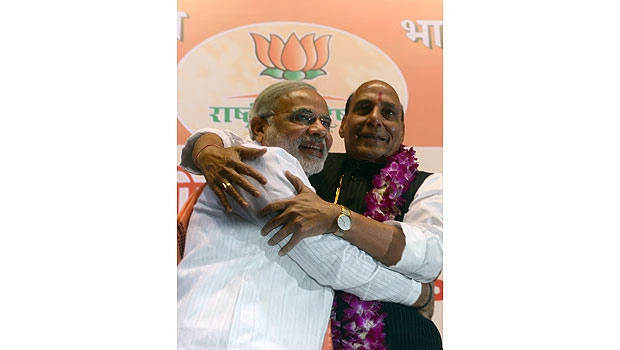
NEW DELHI: The main opposition Hindu nationalist party yesterday elevated Narendra Modi, a deeply divisive figure in Indian politics, re-inducting him into the Central Parliamentary Board, its top decision-making body, with his supporters believing he could become prime minister in national elections next year.
However, Rajnath Singh, the Bharatiya Janata Party president, did not name Modi as the party’s prime ministerial candidate, apparently because of opposition from some allies.
Smriti Irani, a BJP vice president, said the party would make a decision on the issue later. It is not known when the party will announce its candidate. The elections are due in May 2014.
Modi was made a member of the board and the central election committee, which will select candidates and lead the election campaign.
Modi, 62, currently heads the BJP government in western Gujarat state. For more than a decade, he has worked relentlessly to market the idea of Gujarat state as a business-friendly state and become a hero to a generation of businessmen.
Modi says he has transformed his state, bringing it industries, jobs, electricity and water in a country where power outages and joblessness are epidemic.
However, Modi is accused by rights groups and survivors of not doing enough to stop the violence and even stoking it when marauding mobs of Hindus killed and burned their way through Muslim neighborhoods in Gujarat state in 2001, leaving more than 1,100 people dead. He was never charged with a crime.
The riots began in February 2002 when a train filled with Hindu pilgrims was attacked by a Muslim mob in a small Gujarat town. A fire erupted — it remains unclear whether it was arson — and 60 Hindus burned to death. In retaliation, Muslims were attacked across the state. Since that bloodletting, Modi has ruled over a state sharply divided along religious lines.
In 2005, the US State Department denied a visa to Modi under the US Immigration and Nationality Act, which bars people responsible for violations of religious freedom from getting a visa.
The Congress party, which has led India’s national government for the past nine years, has seen its position dramatically weakened in recent years, its reputation battered by clumsy political maneuvering, weak leadership and a seemingly endless stream of corruption scandals.
The BJP is expected to pose a strong challenge to the Congress party in the 2014 elections.
Kapil Sibal, a Congress party leader and telecommunications minister, said yesterday that the elevation of a controversial leader would pose a serious challenge to the BJP in the run-up to the elections.
Asked whether Modi’s inclusion is an indicator of his projection as PM candidate, JD (U) Bihar unit spokesman Niraj Kumar said, “JD(U) leadership’s stand in this regard has been known to one and all. We believe that a prime ministerial candidate should have secular credentials to take along diverse group of people of the country.”
Kumar, however, went on to say that Mr. Modi’s induction is an “internal matter” of BJP.
“It (induction of Modi) is an internal matter of the BJP at the national level,” he said in Patna.
In Delhi, JD (U) chief Sharad Yadav said he has no problem with the new team. “I have no problem with it.”
On whether he foresaw any hitches in the future, he said, “Who knows what will happen tomorrow.”
Kumar said that the ‘Bihar Model’ of development was the only guiding mantra on which the country could move forward by representing the aspirations of all sections of society.
Modi inducted into BJP Parliamentary Board