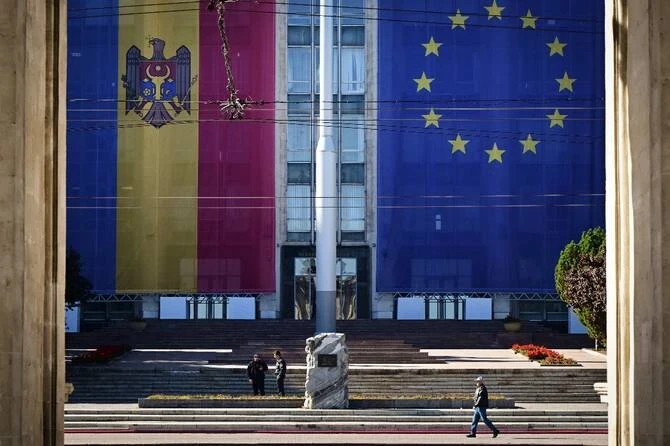
- Grosu emphasized that the weapons will not be supplied to Ukraine but solely for Moldova's own needs
- Moldova's administration aims to join the European Union by 2030
CHISINAU: Moldova’s pro-European government intends to press for changes in legislation to allow for the production of weapons, but needs them for its own defense and has no intention of providing them to neighboring Ukraine, the head of parliament said on Friday.
Parliament Chairman Igor Grosu, the No. 2 official in Moldova’s state hierarchy, said the changes were needed to proceed with the manufacture of dual-purpose weapons, like drones.
“I would very much like for us to produce them for ourselves. We need them, particularly for dual-use purposes,” Grosu told a two-day international security forum, citing drone use for national security, emergencies and agriculture.
Grosu, head of President Maia Sandu’s Action and Solidarity Party, which holds a majority in parliament, dismissed any suggestion that they might be meant for use by Ukraine in its 4-1/2-year-old war with Russia.
“Of course not! Why would we?” he told reporters. “We would produce them for ourselves.”
Sandu’s administration, which wants Moldova to join the European Union by 2030, has been fiercely critical of Moscow’s invasion of Ukraine.
Moldova, lying between Ukraine and EU member Romania, has been buffeted by the war. Increasing numbers of drones and missiles, believed by authorities to be Russian, have intruded into the country’s airspace in recent weeks, with debris crashing on its territory.
Grosu told the forum that 88 such violations of Moldova’s airspace had been recorded since Russia’s February 2022 invasion.
“With such figures, people are asking a simple question: Can our state defend us?” he said.
“We cannot provide this defense overnight. And we cannot in four years make up for 30 years of failing to finance our defense. To protect our airspace we need radar, equipment, trained personnel, communications, infrastructure and procedures.”
Sandu told the forum on Thursday that Moldova’s position in the region was “vulnerable.” She said domestic defense production was a key part of future defense planning and changes to legislation would soon be submitted to parliament.