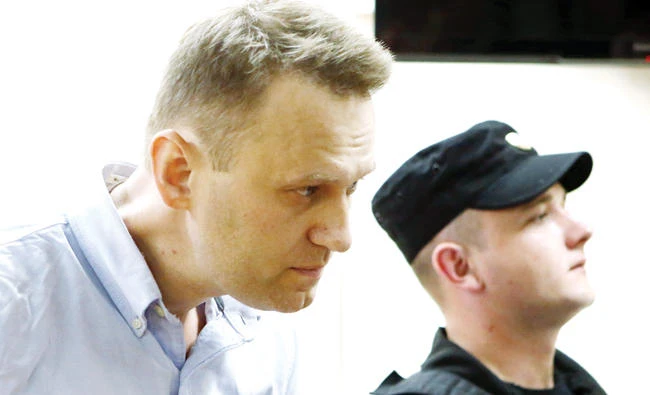
MOSCOW: Russian opposition demonstrators appeared in court on Tuesday after nationwide anti-corruption protests called by leading Kremlin critic Navalny, who was slapped with a 30-day jail sentence.
The Kremlin said on Tuesday that Russian authorities would not pay attention to US calls to release anti-government demonstrators who were detained on Monday.
“We disagree when the question is put this way. This is not the sort of calls we should be listening to,” Kremlin spokesman Dmitry Peskov told a conference call with reporters.
The US condemned Russia’s crackdown on anti-corruption protesters on Monday, calling on Moscow to release “peaceful” demonstrators detained by the police.
Peskov said the authorities had not acted against protesters who had agreed their actions in advance.
“As for those who indulged in provocative actions, breaking the law, in this case the authorities took action against them in full compliance with our legislation,” said Peskov.
He also said that Russia took a negative view of a US Senate deal on wider sanctions against Russia.
US senators reached an agreement on Monday on legislation imposing new sanctions on Russia, including a provision that would prevent the White House from easing, suspending or ending sanctions without congressional approval.
Over 1,700 people were detained at Monday’s demonstrations, mainly in the capital Moscow and Russia’s second city Saint Petersburg, but the Kremlin said police had acted correctly and slammed the “dangerous” actions of protesters.
Several criminal probes into violence against police were launched though protesters said it was the police who used excessive force.
Many spent the night in police stations and were shuttled to court for violating demonstration regulations that could see them spend up to 15 days in jail.
At the Tverskoi District court in Moscow, 19-year-old Roman said he was grabbed by five riot policemen before being bundled into a van with 20 others.
“They put me in an arm lock and hit me in the stomach,” said the student, who could face a fine after attending his first unauthorized rally.
Others were less lucky, with the same court sentencing three people to 10 days in jail.
The Moscow protest was originally sanctioned in a different location but Navalny changed the venue, saying the authorities were blocking efforts to hire a stage and sound equipment. He called on supporters to go to the arterial Tverskaya Street instead.
He himself never made it to the protest as police arrested him in the stairwell of his apartment building before the rally began.
The 41-year-old has announced his intention to run for president against Vladimir Putin and has been campaigning relentlessly around Russia while also mounting a strong online presence via YouTube videos, attracting a younger generation, including minors.
“It (is) clear that the makeup (of the protest) has changed in favor of the youth,” said Ekaterina Schulmann of the Russian Academy of National Economy and Public Administration.
“Participation of the young brings new meaning to any protest. We have considered this generation... to be loyal and conformist, but it demonstrated it is ready to go to the streets.”
“Everything is developing very fast and we cannot predict how it will influence the presidential elections,” she said.
Tverskaya Street on the day of the protest hosted a festival with entertainers in historical costumes to mark the Russia Day public holiday.
As a result there were surreal scenes with demonstrators shouting slogans as people in period outfits held sword fights.
Kremlin spokesman Dmitry Peskov said authorized rallies were “normal” but dubbed people taking their protest to city festivities as “provocateurs.”
“Their actions were dangerous for the public and police takes adequate measures against such individuals,” he said.
On Tuesday, the powerful Investigative Committee said one protester “sprayed tear gas into the eyes of a riot police officer who was carrying out his duties during the unsanctioned rally” and would be charged.
Another criminal case was launched in Saint Petersburg, where a policeman had a tooth knocked out, local news website Fontanka reported.
The protests in cities from fareastern Vladivostok to the Black Sea resort of Sochi and Norilsk beyond the Arctic Circle, follow a previous unsanctioned rally called by Navalny on March 26 that sparked a similar police reaction.
The rallies are the largest to be held Russia-wide since a wave of street actions protesting against Putin’s reelection to a third Kremlin term in 2011-12.
After that, the Kremlin initiated a series of repressive laws criminalyzing unsanctioned gatherings.
They also follow a film made by Navalny’s team that accuses Prime Minister Dmitry Medvedev of amassing vast personal wealth, which is controlled through a network of shadowy foundations. It has been viewed over 22 million times on YouTube.
The arrests have drawn condemnation from Washington, Brussels and several human rights organizations, who called on protesters to be released.
“The Russian people deserve a government that supports an open marketplace of ideas,” White House spokesman Sean Spicer said.
Amnesty International said that, “a crackdown on peaceful protests in which hundreds of people were arrested and numerous others beaten by police demonstrates the authorities’ utter contempt for fundamental human rights.”
The Kremlin said on Tuesday that Russian authorities would not pay attention to US calls to release anti-government demonstrators who were detained on Monday.
“We disagree when the question is put this way. This is not the sort of calls we should be listening to,” Kremlin spokesman Dmitry Peskov told a conference call with reporters.
The US condemned Russia’s crackdown on anti-corruption protesters on Monday, calling on Moscow to release “peaceful” demonstrators detained by the police.
Peskov said the authorities had not acted against protesters who had agreed their actions in advance.
“As for those who indulged in provocative actions, breaking the law, in this case the authorities took action against them in full compliance with our legislation,” said Peskov.
He also said that Russia took a negative view of a US Senate deal on wider sanctions against Russia.
US senators reached an agreement on Monday on legislation imposing new sanctions on Russia, including a provision that would prevent the White House from easing, suspending or ending sanctions without congressional approval.
Over 1,700 people were detained at Monday’s demonstrations, mainly in the capital Moscow and Russia’s second city Saint Petersburg, but the Kremlin said police had acted correctly and slammed the “dangerous” actions of protesters.
Several criminal probes into violence against police were launched though protesters said it was the police who used excessive force.
Many spent the night in police stations and were shuttled to court for violating demonstration regulations that could see them spend up to 15 days in jail.
At the Tverskoi District court in Moscow, 19-year-old Roman said he was grabbed by five riot policemen before being bundled into a van with 20 others.
“They put me in an arm lock and hit me in the stomach,” said the student, who could face a fine after attending his first unauthorized rally.
Others were less lucky, with the same court sentencing three people to 10 days in jail.
The Moscow protest was originally sanctioned in a different location but Navalny changed the venue, saying the authorities were blocking efforts to hire a stage and sound equipment. He called on supporters to go to the arterial Tverskaya Street instead.
He himself never made it to the protest as police arrested him in the stairwell of his apartment building before the rally began.
The 41-year-old has announced his intention to run for president against Vladimir Putin and has been campaigning relentlessly around Russia while also mounting a strong online presence via YouTube videos, attracting a younger generation, including minors.
“It (is) clear that the makeup (of the protest) has changed in favor of the youth,” said Ekaterina Schulmann of the Russian Academy of National Economy and Public Administration.
“Participation of the young brings new meaning to any protest. We have considered this generation... to be loyal and conformist, but it demonstrated it is ready to go to the streets.”
“Everything is developing very fast and we cannot predict how it will influence the presidential elections,” she said.
Tverskaya Street on the day of the protest hosted a festival with entertainers in historical costumes to mark the Russia Day public holiday.
As a result there were surreal scenes with demonstrators shouting slogans as people in period outfits held sword fights.
Kremlin spokesman Dmitry Peskov said authorized rallies were “normal” but dubbed people taking their protest to city festivities as “provocateurs.”
“Their actions were dangerous for the public and police takes adequate measures against such individuals,” he said.
On Tuesday, the powerful Investigative Committee said one protester “sprayed tear gas into the eyes of a riot police officer who was carrying out his duties during the unsanctioned rally” and would be charged.
Another criminal case was launched in Saint Petersburg, where a policeman had a tooth knocked out, local news website Fontanka reported.
The protests in cities from fareastern Vladivostok to the Black Sea resort of Sochi and Norilsk beyond the Arctic Circle, follow a previous unsanctioned rally called by Navalny on March 26 that sparked a similar police reaction.
The rallies are the largest to be held Russia-wide since a wave of street actions protesting against Putin’s reelection to a third Kremlin term in 2011-12.
After that, the Kremlin initiated a series of repressive laws criminalyzing unsanctioned gatherings.
They also follow a film made by Navalny’s team that accuses Prime Minister Dmitry Medvedev of amassing vast personal wealth, which is controlled through a network of shadowy foundations. It has been viewed over 22 million times on YouTube.
The arrests have drawn condemnation from Washington, Brussels and several human rights organizations, who called on protesters to be released.
“The Russian people deserve a government that supports an open marketplace of ideas,” White House spokesman Sean Spicer said.
Amnesty International said that, “a crackdown on peaceful protests in which hundreds of people were arrested and numerous others beaten by police demonstrates the authorities’ utter contempt for fundamental human rights.”