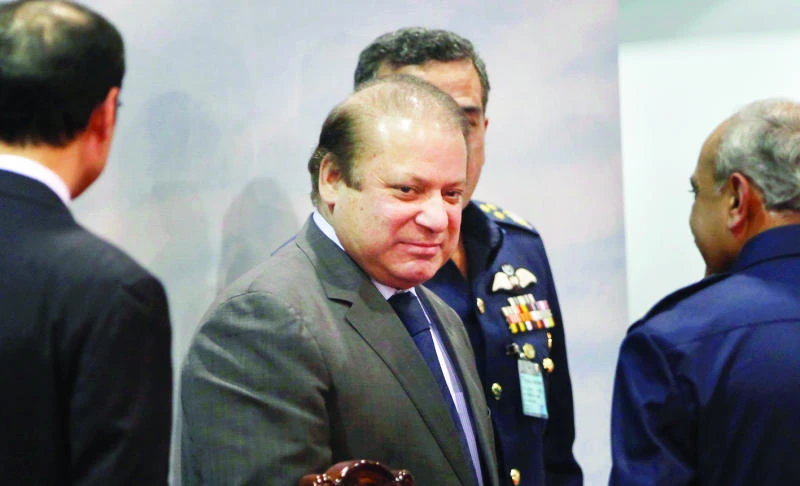
ISLAMABAD/WASHINGTON: Pakistan’s prime minister says his government will pursue peace talks with militants despite a recent spate of attacks, naming a four-member committee to facilitate the talks.
Prime Minister Nawaz Sharif on Wednesday scotched speculation his government would launch an offensive against the Taleban following a wave of bloody attacks, saying he wanted to “give the peaceful solution another chance.”
He also called on the militants to observe a cease-fire in a televised speech to lawmakers at Parliament.
Sharif long has supported talks as the best way to end the years of fighting with the militants in the country’s northwest.
But after a spate of attacks in January, he has been under pressure to take steps to bring the country’s violence under control, raising questions about whether he would authorize a large-scale military operation against militants like the Pakistani Taleban and other extremist groups.
On the other hand, a senior Pakistani official said Tuesday that the government was increasingly inclined to wage an offensive against the local Taleban.
On a visit to Washington, where officials have long backed action against extremist outposts, Prime Minister Nawaz Sharif’s national security adviser Sartaj Aziz described semi-autonomous North Waziristan as the “last challenge” in asserting state control.
“The government decided initially in consultation with all political parties to have a dialogue with the Taleban,” Aziz said.
“But that is proving much more difficult, so the other option of using force... is likely to be now considered more seriously,” he said at Johns Hopkins University’s School of Advanced International Studies.
Sharif’s government has come under fire for failing to come up with a strategy to respond to a surge in militant violence, which has seen more than 114 people killed in attacks since the start of the year, according to an AFP tally.
Sharif was elected to office last year vowing to bring an end to a homegrown Taleban insurgency that has raged since 2007, by engaging militants in meaningful dialogue.
But preliminary efforts to reach out to the Taleban ended after a US drone strike killed their then-leader Hakimullah Mehsud in November.
The Taleban have since said they will only talk if the Pakistan army withdraws from the country’s restive tribal areas that border Afghanistan, and puts an end to US drone strikes.
In a highly-anticipated address to Pakistan’s Parliament Wednesday, Sharif paid an emotional tribute to the victims of terrorism, saying: “Common citizens are being targeted and our innocent children are dying. Society is surrounded by fear.”
He also slammed the Taleban for rejecting the government’s first offer of talks and distorting the teachings of Islam, adding: “Our very existence is endangered. We cannot make the nation and the country hostage to militants.”
He continued: “I know that today if state wants to eliminate terrorists by force, the entire nation will stand by it, however, when the offer of talks has come to fore from the other side, we ... want to give the peaceful solution another chance.”
To aid in the renewed dialogue efforts Sharif said he would form a four-man committee that includes leading journalist Rahimullah Yousufzai.
Reacting to the speech, opposition scion Bilawal Bhutto Zardari, the 25-year-old son of slain premier Benazir Bhutto,accused Sharif of appeasing terror.
“Support NS (Nawaz Sharif). I want him to be our Churchill. Unfortunately he is becoming our Neville Chamberlain pursuing policy of appeasement,” he tweeted.
Sharif swept to power last year calling for a negotiated solution with the Taliban but has come under pressure after a bloody start to the year. Some 110 people have been killed in attacks in January, according to an AFP tally.
The government initially hesitated at full-scale military action, fearing that it would set off violent reprisals in Pakistan’s cities.
The United States has long pressured Pakistan to do more to wipe out militant strongholds, saying insurgents were using rear bases in North Waziristan to mount attacks on US troops in Afghanistan.
The United States has taken action on its own through drone attacks on Pakistani territory, which are deeply unpopular with the Pakistani public due in part to civilian casualties.
“We think they are becoming counter-productive and lead to collateral damage which creates more problems,” Aziz said.
Aziz met Monday with Secretary of State John Kerry, who promised sustained economic support and credited the country’s security efforts, saying: “I think few have suffered more at the hands of terrorists and extremists than the people of Pakistan.”
Opposition scion Bilawal Bhutto Zardari, the 25-year-old son of slain premier Benazir Bhutto, earlier told the BBC that Pakistan should take military action against the Taliban as the country has “exhausted the option of talks.”
Nawaz Sharif seeks talks with Taleban; official hints at action