ZAMBOANGA, Philippines: Philippine forces have killed or captured nearly 100 of the rebel guerrillas who have held scores of hostages for a week in a southern city, as the government pushes ahead with an offensive to retake rebel-held coastal communities, officials said Sunday.
Sporadic clashes continued as soldiers moved to clear Moro National Liberation Front (MNLF) gunmen from coastal neighborhoods and cut off escape routes after a cease-fire plan collapsed.
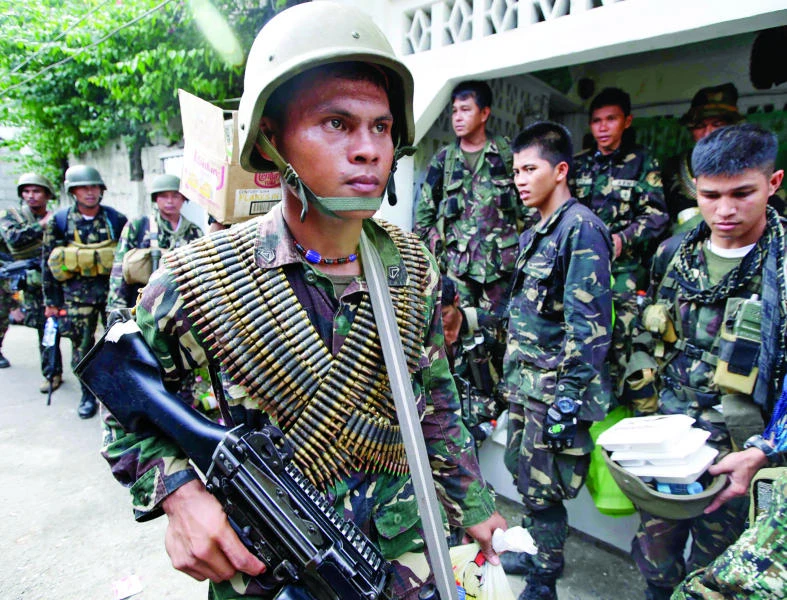
Army troops and police special forces have regained rebel-held grounds and are pressing an assault deeper into communities in the coastal outskirts of Zamboanga city, where more than 100 Moro National Liberation Front guerrillas are holding hostages, military spokesman Lt. Col. Ramon Zagala said.
Lt. Col. Zagala told AFP a number of MNLF rebels had surrendered Sunday, and some had been captured while trying to escape in civilian clothes. Several hostages have escaped or were freed, but it was unclear how many were still in rebel custody.
Zamboanga City Mayor Isabelle Climaco-Salazar said the rebels were still holding up to 40 hostages in one community alone.
Zagala said troops taking part in the offensive were calibrating their firepower to avoid harming civilians.
“We’re gaining ground, we’re pushing forward,” he said.
At least 51 rebels have been killed and over 42 captured, most while trying to escape along the coast after discarding their camouflage uniforms for ordinary clothes, Interior Secretary Mar Roxas said, adding that the gunmen would face criminal charges.
The bodies of two rebels, a man and a woman, were found Sunday by advancing troops.
Six policemen and soldiers, along with four villagers, have been killed in the standoff, which began Monday when troops foiled an attempt by the rebels to march and hoist their flag at Zamboanga’s city hall. The rebels, who arrived by boat from outlying islands, barged into five coastal villages and took more than 100 hostages as human shields.
Army troops and police, backed by helicopters and navy gunboats, initially surrounded the rebels with their hostages while government officials tried to convince the insurgents to free their captives and surrender. But government forces decided to attack Friday after the guerrillas started setting on fire clusters of houses and fired mortar rounds that wounded several Red Cross aid workers, Zagala said.
While the government’s offensive is gaining momentum, Roxas said it’s difficult to tell when the troops will be able to end the standoff, which has displaced more than 67,000 residents.
The crisis has virtually paralyzed the port city of nearly a million people, after authorities closed its international airport, suspended sea ferry services and shut down schools and offices. Officials of a Zamboanga city hospital evacuated 472 patients as clashes erupted nearby last week. They pleaded to the military Sunday to help them return to the hospital to retrieve ventilators, anesthesia machines and other equipment for their patients.
The Moro insurgents, led by rebel leader Nur Misuari, signed a peace deal in 1996, but the guerrillas did not lay down their arms and later accused the government of reneging on a promise to develop long-neglected regions in the south of the nation.
The rebels have become increasingly restive in recent months as they’ve been overshadowed by a rival rebel group that engaged President Benigno Aquino III’s government in peace talks brokered by Malaysia. The talks have steadily progressed toward a new and potentially larger autonomy deal for minority in the south.
Misuari, whose group launched a similar attack in Zamboanga city in 2001, has not been seen in public since the standoff began.
A cease-fire plan brokered by Vice President Jejomar Binay and MNLF leader Nur Misuari was abandoned Saturday after the two sides failed to agree terms.
The MNLF waged a 25-year guerrilla war for independence before signing a peace treaty in 1996 that granted limited self-rule to the south’s minority.
Misuari, who has accused the government of violating the terms of a 1996 treaty by negotiating a separate deal with a rival faction, had disappeared from public view shortly before the fighting began Monday.
The rival faction, the Moro Islamic Liberation Front (MILF), is in the final stages of peace talks with Manila and is expected to take over an expanded autonomous region in the south by 2016.
President Benigno Aquino said the peace talks with the MILF aimed to end decades of rebellion that had claimed 150,000 lives in the country’s southern regions.
Nearly 100 Philippine rebels killed, captured