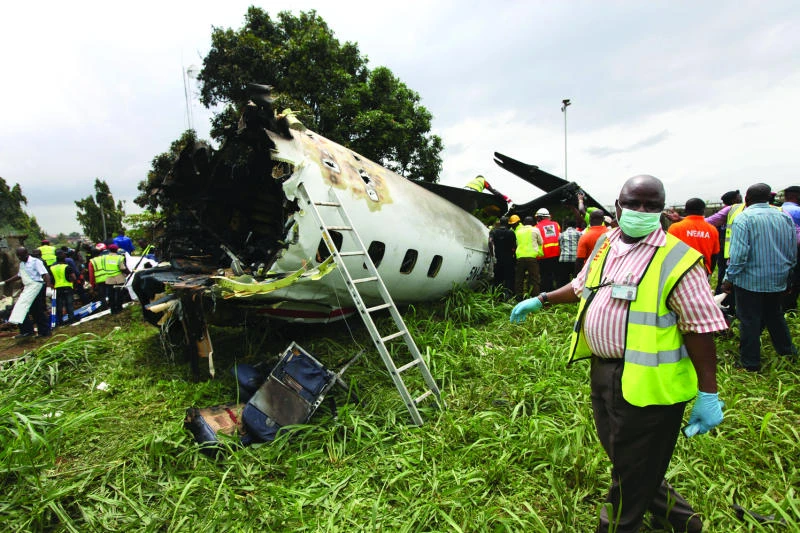
LAGOS: A preliminary investigation into a plane crash that killed at least 13 people in Nigeria indicated that the crew was concerned about the aircraft even before departure and that the captain took off despite continuous automated voice warnings and the first officer’s suggestion they abort the flight.
Associated Airline’s Brazilian-made Embraer-120 aircraft “impacted the ground in a nose-down near 90-degree right bank” after an apparent aerodynamic stall, said the report from Nigeria’s Accident Investigation Bureau.
Flight 361 burst into flames meters from tanks at a fuel depot, minutes after taking off Oct. 3 from Murtala Muhammed Airport in Lagos. It was carrying 13 passengers and seven crew members. Officials have given differing death tolls between 13 and 16, and have not said if the pilot survived.
DNA tests are being carried out on the remains of victims, indicating some were burned beyond recognition. Investigators are looking into the crew’s training in light of its decision to fly despite “concerns regarding the aircraft’s suitability,” Friday’s report said. They are also focusing on mechanical and electronic issues with the right engine and right engine propeller systems.
The report does not elaborate on what the crew said before departure, saying the investigation has yet “to determine the specific nature of the crew’s concerns.”
It was compiled in part from the cockpit voice recorder and flight data recorder.
The first warning came four seconds after engine power was advanced to begin the takeoff roll. The automated warning suggested the flaps were not in the correct position for takeoff, but the crew did not appear surprised and carried on even as the warnings continued.
The first officer noted the aircraft was moving slowly. Four seconds later another automated warning indicated the propeller was not producing any thrust.
The first officer asked if the takeoff should be aborted, but the captain indicated they should continue.
The first officer did not make the customary calls of the speed at which a decision is made to abort or continue takeoff. Instead, “the first officer stated ‘gently,’ which we believe reflects concern, that the aircraft is not performing normally and therefore needs to be rotated very gently so as not to aerodynamically stall the aircraft.”
Ten seconds later, the stall warning sounded in the cockpit.
Nigeria: Pilot of crashed plane ignored warnings