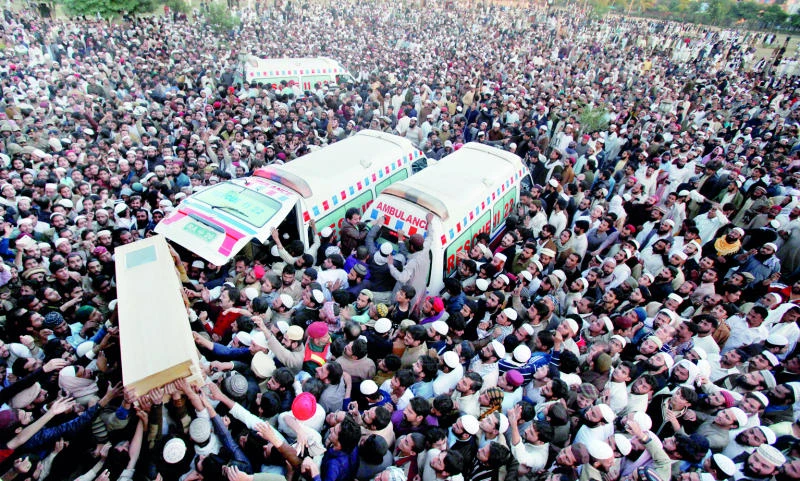
RAWALPINDI: Pakistan on Sunday ordered an inquiry into sectarian violence in the garrison city of Rawalpindi that killed nine people, injured 60 and sparked clashes around the country, officials said.
Fighting erupted on Friday in the garrison-city, which neighbors the capital Islamabad, when a procession by Shiite Muslims to mark the most important day of the mourning month of Muharram coincided with a sermon at a nearby Sunni mosque.
The groups attacked each other, TV cameramen and security forces, firing gunshots.
Rawalpindi has been under nearly complete curfew since the incident, which saw a large number of troops deployed there as well as in the southern city of Multan and Chishtian town to keep the peace.
Judge Mamoon Al-Rasheed of the Lahore High Court will head the probe, a court official said.
Meanwhile, Shahbaz Sharif, who is the chief minister of the Punjab province where the violence occurred, held talks with religious scholars in Rawalpindi and discussed compensation for the families of those killed, state television reported.
Residents are now facing a shortage of food, as the curfew was lifted for only three hours late on Saturday when no shops were open.
“All shops, bakeries and restaurants are closed, the roads are deserted and I am running out of food and other essential items now,” Shafiq Ahmed, a resident of the Satellite Town district said.
“Last night the curfew break was announced abruptly and only a few people came out of their homes, but they found closed markets and returned empty handed,” he added.
Mohammad Shehzad, another resident, said that he bought food every Sunday, but because of the curfew everything was shut and he was prevented by police and troops from going out.
Pakistan is rife with sectarian clashes, with Sunni militant groups linked to Al-Qaeda and the Taleban often attacking gatherings by Shiites, who constitute some 20 percent of the country’s overwhelmingly Muslim population.
Drone protest postponed
Right-wing Pakistani political parties on Sunday postponed a scheduled blockade of NATO supply lines meant to protest the killing of the Taleban chief, citing recent sectarian clashes.
Pakistan reacted angrily earlier this month to a US drone attack that killed Pakistani Taleban chief Hakimullah Mehsud, saying the strike had sabotaged peace talks with the insurgents.
Former cricketer Imran Khan, head of the Pakistan Tehreek-e-Insaaf (PTI) party, called for a blockade of NATO convoys to Afghanistan to force the US to abandon its drone program.
Khan had set a Nov. 20 deadline for the halting of drone strikes and threatened to block supply trucks in northwestern Khyber Pakhtunkhwa, where his party leads a coalition government.
He announced via Twitter on Sunday the protest would now be held on Nov. 23.
Shabeer Ahmad Khan, a leader of Jamaat-e-Islami (JI), the country’s main religious party, earlier announced the postponement at a joint press conference with the PTI and smaller parties.
Shabeer said that sectarian clashes that occurred in Rawalpindi on Friday were the reason for the delay.
“Drone strikes are attacks on the sovereignty of Pakistan and to protect it some practical steps have to be taken,” he added.
Pakistan orders probe into violence