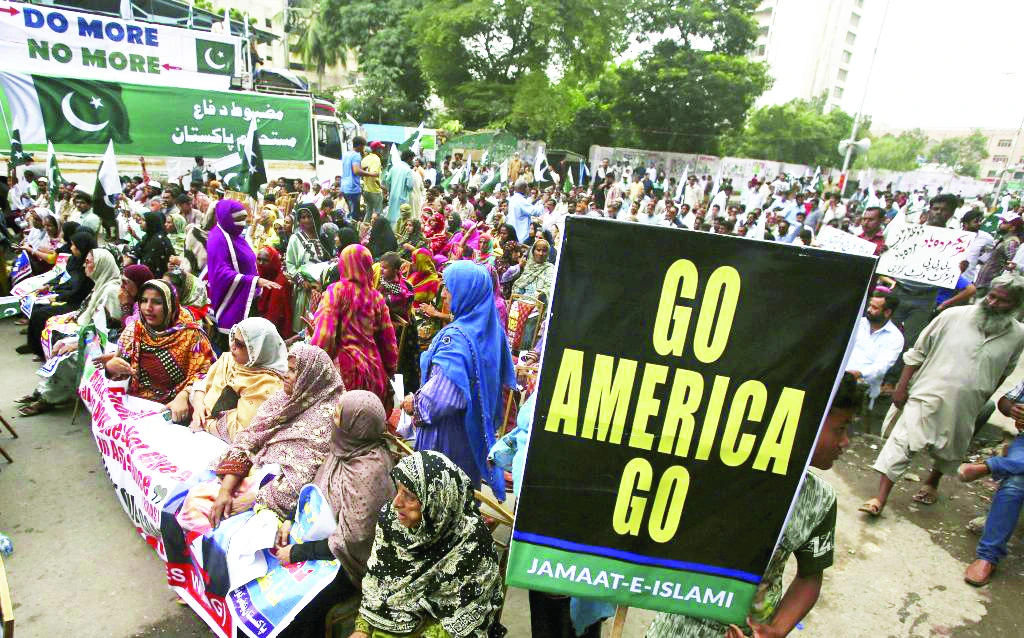
ISLAMABAD: Pakistani MPs on Thursday unanimously approved a resolution presented by Foreign Minister Khawaja Asif rejecting the new US strategy in Afghanistan.
Meanwhile, opposition leader Khurshid Shah asked that a joint session of Parliament be held immediately after Eid Al-Adha to compose an appropriate response to anti-Pakistan statements made by US President Donald Trump during his televised address to the nation.
During his speech on Aug. 21, Trump said Pakistan harbors “agents of chaos” and protects militant groups that allegedly use Pakistani soil to launch attacks against the US-backed Afghan government.
Asif advised MPs to postpone all official visits to the US, and scheduled visits by American delegations to Pakistan.
A visit by the US Acting Assistant Secretary of State Alice Wells to discuss the Trump administration’s new Afghan policy was postponed without reason in a statement issued on Sunday by Pakistan’s Foreign Ministry.
Former Interior Minister Chaudhry Nisar Ali Khan said resolutions and condemnation will not halt US criticism.
He urged Islamabad to revisit the rules of engagement with the US since it continues to blame Pakistan for its own failures in the region.
“The US did not ask Pakistan before going to Afghanistan,” Khan said, adding that America chose to talk with the Taliban, but when Pakistan does so it is unacceptable to Washington.
Javed Hafiz, a retired Pakistani diplomat, told Arab News that Parliament’s resolution was hashed out prematurely.
“Have (MPs) thoroughly studied our deficit, neighboring relations and our dependency on the IMF (International Monetary Fund), which the US controls?” he asked.
“Before adopting any confrontational policy, they need to take a step back and open doors for talks. The current approach isn’t right.”
Parliament concluded its session by demanding the formulation of an economic policy in case US reimbursements under the Coalition Support Fund are further slashed or halted.
The resolution said Afghanistan, the US and its allies should better manage the border and stop terrorists from attacking Pakistan.
It added that the US tilt toward India would create an imbalance between the nuclear rivals, thus destabilizing the region. The US ambassador is to be summoned and briefed on Pakistan’s reservations.
A Foreign Ministry official told Arab News that Asif will lead a delegation to China, Russia, Turkey and Iran to hold talks with the regional stakeholders following the resolution.
Mosharraf Zaidi, a foreign policy expert and former advisor to ex-Foreign Minister Hina Rabbani Khar, told Arab News that Pakistan should maintain a working relationship with the US while engaging other countries.
Meanwhile, opposition leader Khurshid Shah asked that a joint session of Parliament be held immediately after Eid Al-Adha to compose an appropriate response to anti-Pakistan statements made by US President Donald Trump during his televised address to the nation.
During his speech on Aug. 21, Trump said Pakistan harbors “agents of chaos” and protects militant groups that allegedly use Pakistani soil to launch attacks against the US-backed Afghan government.
Asif advised MPs to postpone all official visits to the US, and scheduled visits by American delegations to Pakistan.
A visit by the US Acting Assistant Secretary of State Alice Wells to discuss the Trump administration’s new Afghan policy was postponed without reason in a statement issued on Sunday by Pakistan’s Foreign Ministry.
Former Interior Minister Chaudhry Nisar Ali Khan said resolutions and condemnation will not halt US criticism.
He urged Islamabad to revisit the rules of engagement with the US since it continues to blame Pakistan for its own failures in the region.
“The US did not ask Pakistan before going to Afghanistan,” Khan said, adding that America chose to talk with the Taliban, but when Pakistan does so it is unacceptable to Washington.
Javed Hafiz, a retired Pakistani diplomat, told Arab News that Parliament’s resolution was hashed out prematurely.
“Have (MPs) thoroughly studied our deficit, neighboring relations and our dependency on the IMF (International Monetary Fund), which the US controls?” he asked.
“Before adopting any confrontational policy, they need to take a step back and open doors for talks. The current approach isn’t right.”
Parliament concluded its session by demanding the formulation of an economic policy in case US reimbursements under the Coalition Support Fund are further slashed or halted.
The resolution said Afghanistan, the US and its allies should better manage the border and stop terrorists from attacking Pakistan.
It added that the US tilt toward India would create an imbalance between the nuclear rivals, thus destabilizing the region. The US ambassador is to be summoned and briefed on Pakistan’s reservations.
A Foreign Ministry official told Arab News that Asif will lead a delegation to China, Russia, Turkey and Iran to hold talks with the regional stakeholders following the resolution.
Mosharraf Zaidi, a foreign policy expert and former advisor to ex-Foreign Minister Hina Rabbani Khar, told Arab News that Pakistan should maintain a working relationship with the US while engaging other countries.