MANILA: The Philippine defense chief said Tuesday that disagreements between US and Filipino negotiators are prolonging talks on an accord allowing an increase in American military presence in the country.
Negotiations began in August on a defense agreement that would allow larger numbers of US troops to have temporary access to Philippine military camps and bring in aircraft, ships and other equipment. US troops have already been allowed to train Filipino anti-terrorism forces in the southern Philippines since 2002.
Defense Secretary Voltaire Gazmin said one key issue involves a US failure to clearly accept Philippine control over and access to temporary American facilities to be set up in local camps.
“They can’t say yes or no but what will happen if we won’t have access? Those bases will look like their bases,” Gazmin said in a telephone interview.
“You can say there is a kind of an impasse, a disagreement,” he said, but added he was optimistic that the differences could be overcome.
US Embassy officials did not immediately comment.
Philippine negotiators have been told to ensure that any agreement would comply with the Philippine Constitution and laws and that the US would not have exclusive use of any facility established within selected Philippine military camps, Philippine officials have said.
There were also differences on how to word certain provisions of the agreement, Gazmin said.
The next negotiating session has not been scheduled. The differences mean an agreement may be reached next year at the earliest.
The Philippines’ desire to bolster its defense while engaged in territorial disputes in the South China Sea has dovetailed with Washington’s intention to pivot away from years of heavy military engagement in Afghanistan and Iraq to Asia.
Hundreds of American troops have been stationed in the southern Philippines for counter-terrorism training since 2002.
The presence of foreign troops is a sensitive issue in the Philippines, a former American colony. The Philippine Senate voted in 1991 to close down major US bases. A pact ratified in 1999 allowed temporary visits such as joint exercises.
Cyber attacks
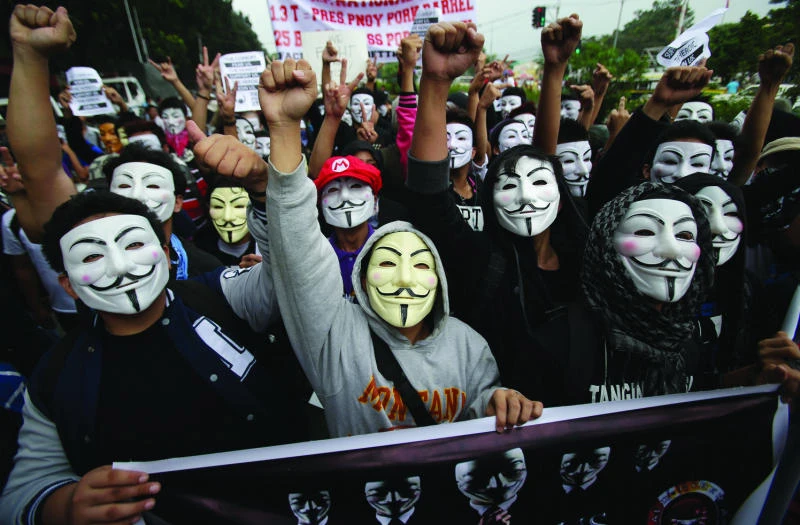
Meanwhile, some 100 masked members of the hacking group Anonymous Philippines marched on parliament Tuesday, denouncing corruption and pledging more cyber attacks, a week after 30 government websites were paralyzed.
The hackers — wearing Guy Fawkes masks — faced off with dozens of riot police outside the House of Representatives in suburban Quezon city north of Manila, blocking the road and bringing traffic to a standstill for around an hour.
“We are here today to press for a new system of government,” said one of the leaders who did not give his name.
“We are everyone and anyone. We will not go away and we will continue with our activities.” Mostly dressed in black, the hackers chanted anti-government slogans and held placards that read: “The corrupt fear us, the honest support us, the heroic, join us.” Last week, the group launched simultaneous cyber attacks that temporarily paralyzed more than 30 government websites.
They defaced the sites with messages calling on the public to support their cause.
The government says it will prosecute members of the group, but has conceded it is yet to determine their identities.
Global activist network Anonymous have carried out a number of attacks and threats in recent weeks.
The Indonesia group claimed last week it had defaced more than 170 Australian websites while the Singapore government boosted its defenses after a threat.
In the Philippines, the movement is protesting against perceived corruption in the legislature over the misuse of billions of dollars of development funds by politicians.
President Benigno Aquino has been hit by the scandal after one of the senators named in the case alleged that his office had misused funds.
Last week, with public anger growing, Aquino went on national television to publicly declare that he was “not a thief” in an attempt to head off the growing crisis that threatens to derail his political agenda.
Philippines, US disagree in troop deployment talks