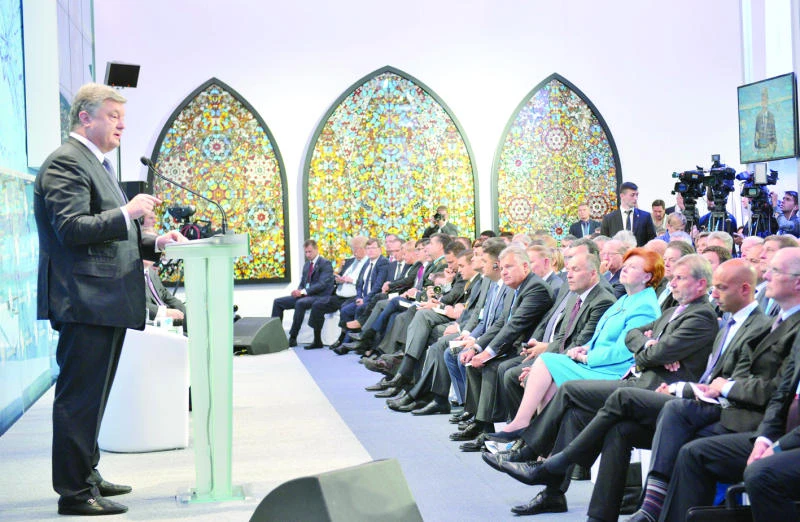
KIEV: Ukrainian President Petro Poroshenko told an international conference Friday that Russia remained a threat but that he held out hope a new truce with pro-Moscow insurgents would hold.
The Western-backed leader told an audience of about a hundred global investors and top diplomats that they must press Russian President Vladimir Putin harder to fulfil the disputed terms of a tentative peace deal to the 17-month war.
Ukraine is increasingly concerned that the European Union’s attention was been diverted by its growing migrant crisis. Washington is also currently focused on implementing the new Iranian nuclear agreement and conducting strikes against Daesh militants in Syria and Iraq.
Poroshenko warned that Russia was harboring “imperialist” ambitions under Putin and trying to seize back former tsarist and Soviet lands.
“By the aggression against sovereignty and territorial integrity of Ukraine, Russia has actually challenged the entire democratic world,” the 49-year-old former chocolate baron told the Yalta Annual Meeting (YES) that had been held in Crimea until its annexation by Russia last year.
The meeting comes with government forces and pro-Moscow insurgents largely abiding by a new September 1 cease-fire that is meant to reinforce a broader — but repeatedly broken — deal signed in February in the Belarussian capital Minsk.
“The cease-fire is in place for almost two weeks and not a dream anymore,” said Poroshenko.
He added that his telephone talks Wednesday with Putin and the leaders of Germany and France “strengthened my feeling of cautious optimism.”
The February pact is designed to end one of Europe’s deadliest conflicts in decades by the end of the year. It is also meant to give broader autonomy to the Russian-speaking Lugansk and Donetsk regions within a unified Ukraine.
But the sides have fought bitterly over how the 13-point deal should come into force.
Russia has blamed Kiev for the political impasse and backed the separatists diplomatically in heated United Nations Security Council debates throughout the past year.
The European Union and Washington have slapped trade and personal sanctions against Russia that — together with the recent plunge in commodity prices — have pulled the former superpower into recession and seen its currency shed half its value since the conflict broke out.
Poroshenko says Ukraine truce holding despite Russia ‘threat’