SEOUL: North Korea has “flatly rejected” a UN statement vowing to punish its latest banned missile test with tighter sanctions.
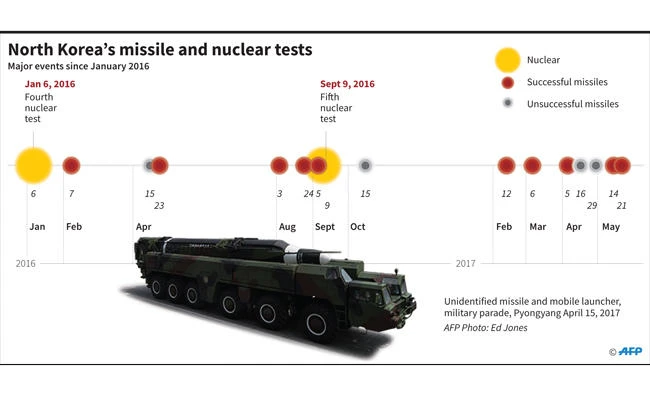
In a unanimous statement backed by Pyongyang’s ally China, the UN Security Council on Monday strongly condemned Sunday’s test-firing of the medium-range Pukguksong-2, instructing the UN sanctions committee to redouble efforts to implement a series of tough measures adopted last year.
A spokesman for Pyongyang’s foreign ministry blamed what it called “the US and its followers” for the declaration, the official Korean Central News Agency reported, saying they were “obsessed by inveterate repugnancy and hostility.”
“It is absolutely ridiculous to see them finding fault with the DPRK’s every measure for self-defense,” the spokesman added, using the acronym for the North’s official name. “We flatly reject the press statement.”
Pyongyang habitually issues threats and says it needs nuclear weapons to defend itself against the risk of invasion.
It has carried out two atomic tests and dozens of missile launches since the beginning of last year in its quest to develop a missile capable of delivering a nuclear warhead to the continental US.
The administration of US President Donald Trump has said military action was an option under consideration, sending fears of conflict spiralling.
More recently the US has said it is willing to enter into talks with North Korea if it halts its nuclear and missile tests.
The US-drafted Security Council statement was agreed on the eve of an emergency meeting requested by the US, Japan and South Korea to discuss a course of action on North Korea.
In it the Council agreed to “take further significant measures including sanctions” to force North Korea to change course and end its “highly destabilising behavior.”
Meanwhile, US anti-virus firm Symantec said the Lazarus hacking group, widely believed to be connected to North Korea, is “highly likely” responsible for the WannaCry global cyberattack that hit earlier this month,
North Korea has angrily dismissed earlier reports linking its isolated regime to the worm that crippled hundreds of thousands of computers, demanding payment in Bitcoin to return control to users.
But Symantec said the ransomware had many of the hallmarks of other Lazarus attacks, including the 2014 strike on Sony Pictures and a multimillion-dollar theft from the Bangladesh Central Bank.
Without mentioning the group’s links to North Korea, it said that prior to the global outbreak on May 12, an earlier version of WannaCry was used in a small number of attacks in the previous three months.
“Analysis... revealed substantial commonalities in the tools, techniques, and infrastructure used by the attackers and those seen in previous Lazarus attacks, making it highly likely that Lazarus was behind the spread of WannaCry.”
Up to 300,000 computers in 150 countries were hit by the WannaCry worm, which seizes systems and demands payment in Bitcoin to return control to users.
Pyongyang ‘flatly rejects’ UN vow to tighten sanctions