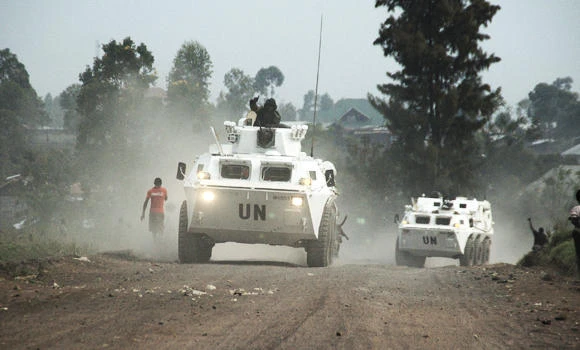
KINSHASA, Congo: Rebels entrenched in the hills above one of eastern Congo’s largest cities declared a unilateral cease-fire on Friday and began retreating from the front-line, the first indication that a joint United Nations and Congolese offensive might be gaining the upper hand in the conflict.
The M23 rebels said Friday that they have begun pulling back from Kanyaruchinya village, which has been in the crosshairs of the fighting that erupted on Aug. 21. They said they were doing so in order to allow UN inspectors a chance to investigate the shelling of nearby towns. Reached by telephone, M23 president Bertrand Bisimwa said that beyond the investigation, his group was declaring the cease-fire in order “to give peace a chance.”
“We have decided to decree a unilateral cease-fire and we have started pulling our forces out of Kanyaruchinya in order to allow the investigation into the shelling,” he told The Associated Press. “This announcement, which was made unilaterally, is meant to allow the Congolese to return to the negotiating table ... and to give peace a chance.” The declaration marks a significant change in tone for the M23 rebels. As recently as Wednesday, Bisimwa maintained that the rebels had the advantage and that UN and Congolese troops had been forced to retreat.
Created in 2012, the M23 rebels succeeded in seizing and briefly holding Goma last year. That prompted the United Nations to create a special intervention brigade, which, alongside Congolese troops, has been pounding rebel positions for the past week, using combat helicopters, artillery and armored personnel carriers. The rebels’ retreat suggests the weeklong offensive against the rebels might have turned a corner.
But in Congo’s capital, Kinshasa, government spokesman Lambert Mende said the call for a cease-fire does not go far enough.
“It’s our opinion that the only interesting proposition would be to see M23 demobilized, and to see them dissolve and cease all military action. Any other proposal is unacceptable,” said Mende, Congo’s minister of information. The fighting, which began last Wednesday has so far claimed the lives of one UN peacekeeper as well as at least 10 Congolese soldiers and 14 civilians who died from the shelling on either side of the Congo-Rwanda border. A recent United Nations Group of Experts report describes how Rwandan soldiers sneak across the forested border in groups of up to 30 men to join the ranks of the M23, a group which is almost entire Tutsi, the ethnic group of Rwanda’s ruling class. Previous UN reports have described the logistical support Rwanda is providing, including night vision goggles.
Late Thursday, Rwanda’s Foreign Minister Louise Mushikiwabo said on Twitter that Rwandan troops could enter Congo. She said in a Tweet that her country is not currently in Congo, and added the word “yet” in parenthesis.
Earlier in the day she had said Rwanda had remained restrained “for as long as we can.”
Rebels in Congo declare cease-fire, begin retreat