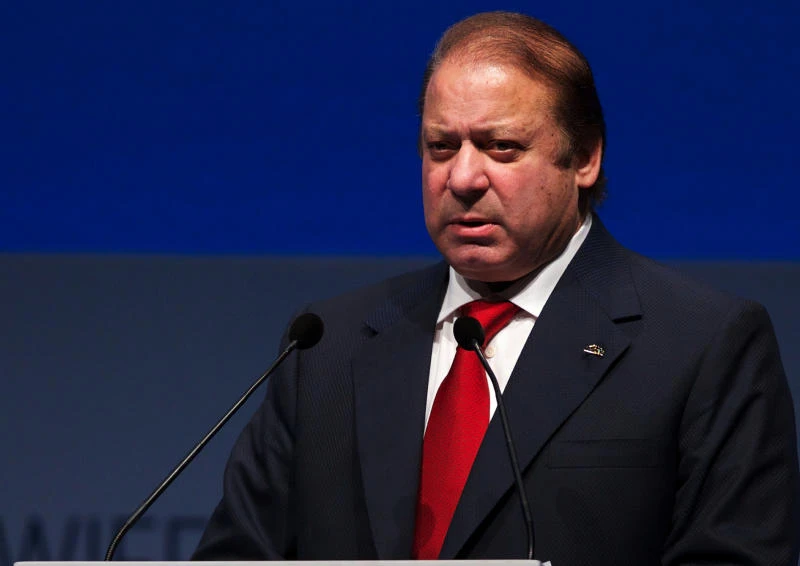
ISLAMABAD: Pakistani Prime Minister Nawaz Sharif on Monday warned peace could not be achieved “by unleashing senseless force,” in his first public speech since a US drone strike killed Taleban leader Hakimullah Mehsud.
The killing of Mehsud on Friday as government representatives prepared to meet his Tehreek-e-Taleban Pakistan (TTP) faction triggered an angry response from Islamabad while Afghan president Hamid Karzai said the strike “took place at an unsuitable time.”
Pakistan’s interior minister Chaudhry Nisar on Saturday accused Washington of sabotaging peace efforts with the drone strike.
Though Sharif did not mention the drone strike directly, he stressed his desire to “give peace a chance.”
“My government is firmly resolved to bringing the cycle of bloodshed and violence to an end.
“But it cannot be done overnight, nor can it be done by unleashing senseless force against our citizens, without first making every effort to bring the misguided and confused elements of society, back to the mainstream,” he said in a speech after army exercises near Bahawalpur in Punjab province.
Sharif is to hold a meeting of his cabinet security committee on Monday evening after a furious Nisar said “every aspect” of Islamabad’s ties with Washington would be reviewed. Afghan leader Karzai meanwhile told a US Congress delegation visiting Kabul he hoped the peace process, still at an embryonic stage, did not suffer as a result, according to a statement released by his office late Sunday.
The TTP operate separately from the Afghan Taleban but notionally pledge allegiance to the same leader, Mullah Omar.
Karzai has been seeking to open peace talks with the Afghan Taleban to end 12 years of war, but the militants have refused to negotiate with his appointees, dismissing him as a puppet of Washington.
Karzai, who recently held talks with Sharif in London, said fraught relations between Kabul and Islamabad had improved.
Pakistan was a key backer of the hard-line 1996-2001 Taleban regime in Kabul and is believed to shelter some of the movement’s top leaders.
Sharif came to power in May partly on a pledge to hold talks to try to end the TTP’s bloody insurgency that has fueled instability in the nuclear-armed nation.
Relations had appeared to be warming after lurching from crisis to crisis in 2011 and 2012.
Opposition parties led by Imran Khan’s Pakistan Tehreek-e-Insaaf party have demanded the government close Pakistan’s roads to convoys supplying NATO forces in Afghanistan.
The party has said it will block NATO convoys in the northwestern province of Khyber Pakhtunkhwa where it is in power, which would cut off one of the main crossing points into Afghanistan.
Pakistan blocked NATO convoys for seven months in 2012 after a botched US air raid killed 24 troops.
With NATO withdrawing 87,000 troops from Afghanistan by the end of next year after 12 years of war, the ground supply lines through Pakistan are of vital importance.
Anti-American sentiment runs deep in Pakistan and drone strikes are hugely unpopular, with many criticizing them both for civilian deaths and as a violation of sovereignty.
But after the heated rhetoric of the weekend, Sharif and his government must weigh the practicalities of their response carefully in the light of improving relations with a vital financial partner.
Last month US President Barack Obama welcomed Sharif to the White House and the State Department announced the release of $1.6 billion in aid, including $1.38 billion for the country’s powerful military.
The money had been frozen as relations plummeted amid a series of crises in 2011 and 2012 including the US raid to kill Osama Bin Laden at his hideout in Pakistan — carried out without Pakistani knowledge.
Washington has said the issue of whether to negotiate with the TTP was an internal matter for Pakistan but stressed the US and Pakistan had “a vital, shared strategic interest in ending extremist violence.”
Sharif says, no peace through ‘senseless force’