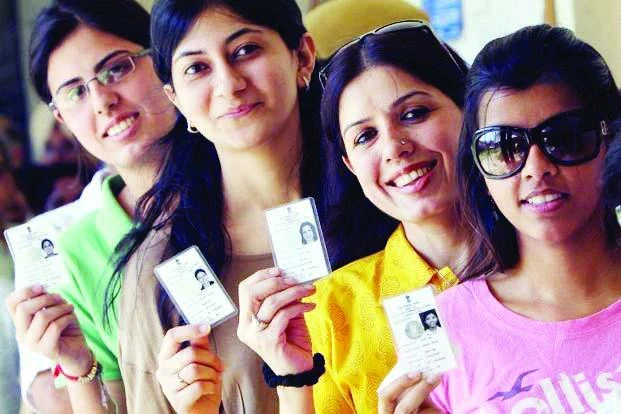
The ongoing marathon Indian general elections have scores of novel features which have left the world in awe — the use of Electronic Voting Machines and indelible ink, to name a few.
The briefcase sized EVMs are 35 to 40 times cheaper than a polling booth size used EVM in the United States. The wonder indelible ink is a silver nitrate dye that is applied on the voter’s forefinger to prevent election fraud as this ‘election stain’ cannot be removed and automatically fades out after a few weeks. India exports indelible ink to 26 countries, including Pakistan and Afghanistan.
But these features have been there in the Indian elections history for decades. There is something new which is happening in India Elections 2014 — and happening in a big way. It is the increasing use of social media. It is not just common man in India who is increasingly using social media tools like Twitter and Facebook, but candidates, political parties and top political leaders too are using social media in these elections like never before.
There are 103 million social media users in India. A large chunk of these users use their mobile phones and smart phones to access the social media.
This is proving to be a deadly combination as India is a country where the number of mobile phone owners exceeds the total number of voters (814 million). These numbers are growing rapidly on a day to day basis.
Consider some more facts. As many as 93 million Indians are on the Facebook and 33 million on Twitter. 66 percent of India’s population of 1.25 billion is below the age of 35 and almost 72 million Indians are in the age bracket of 18 to 23. A large percentage of Indian youth is educated and tech-savvy and the trend is fast spreading to the countryside as well.
Indian youngsters are heavy users of social media and are increasingly switching to 3G and 4G technologies.
These facts have not been lost on the Indian politicians. Most frontline Indian politicians have become aware that social media can be a major influencing factor in at least 160 Lok Sabha constituencies out of a total of 543 as these are the seats where winning margin has been less than five percent.
Besides, in the last general election in 2009 the victory margin in 54 out of 543 constituencies was less than ten thousand votes, which makes it almost ten percent of total Lok Sabha seats. Congress party’s Namo Narain Meena scraped through in Tonk-Sawai Madhopur constituency of Rajasthan by just 317 votes, the lowest victory margin of last general elections.
According to an Electoral Reference Handbook released by the Indian government earlier this month, six victorious candidates in the 2009 polls managed to win by less than 1,000 votes, 27 candidates won with a 1,000-5,000 vote lead, and another 21got home with a victory margin ranging between 5,000 and 10,000 votes.
The Handbook’s party-wise analysis of candidates, who won by less than 10,000 votes, shows that 21 of the 54 closely-contested seats landed in the Congress party’s kitty, followed by the Bharatiya Janata Party (BJP) which emerged winner in 17 seats.
In the history of Gujarat, the home state of the BJP’s prime ministerial candidate Narendra Modi, Congress candidate Satyajit Gaekwad created an Indian record by defeating his BJP rival in Vadodara constituency by a margin of just 17 votes in the 1996 general elections. This record is yet to be broken and, in fact, Gaekwad is the only candidate in the history of Gujarat whose victory margin in a general election was in two digits.
When victory margins are wafer-thin in a large number of countries, every single vote matters. Social media is an effective and no-cost answer to their predicament and hence the increasing reliance on this new medium.
Social media emerges as newest powerful tool in Indian elections