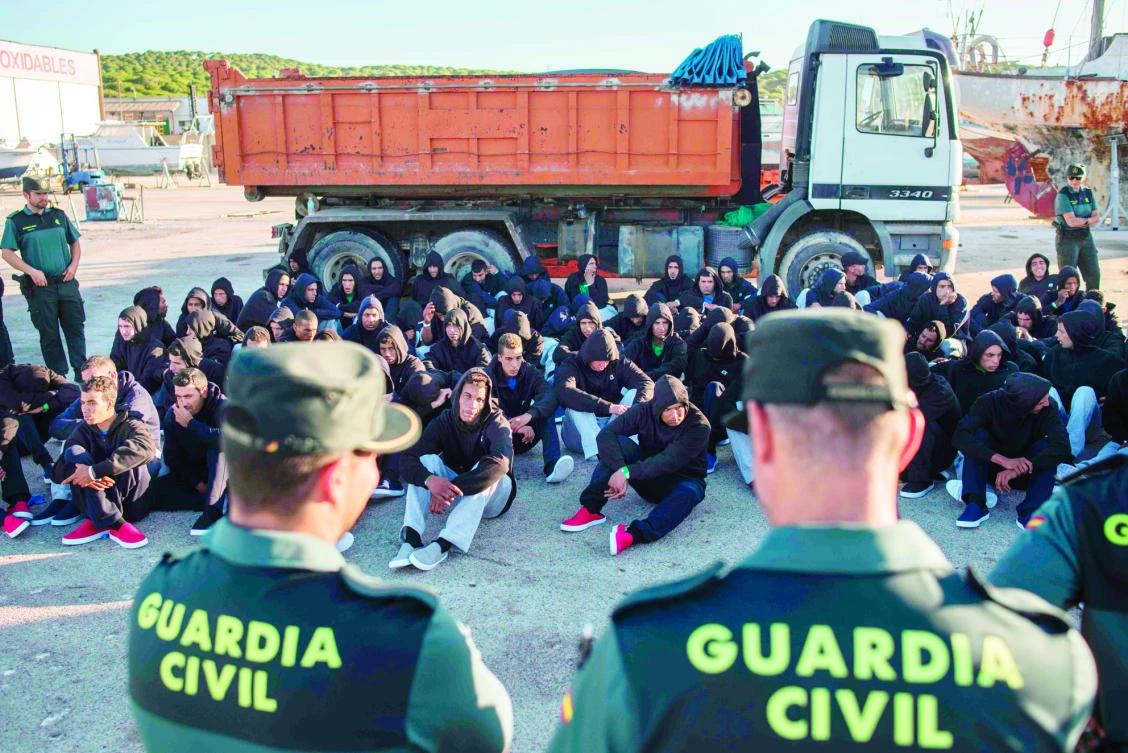
MADRID/DAKAR: The number of migrants crossing into Spain by sea from North Africa has doubled in 2017 from last year, outpacing the Libya-Italy route as the fastest growing entry point to Europe.
The UN Refugee Agency (UNHCR) said the spike in migrant boats is already putting a lot of stress on Spain’s insufficient migration structures.
Escaping poverty and conflicts, more than 360,000 refugees and migrants arrived on European shores across the Mediterranean last year, according to the UNHCR. More than 85,000 have reached Italy so far this year. Spain’s Interior Ministry did not return calls and e-mails seeking comment.
While the Italian sea route remains the most popular overall with 59,000 migrants between January and May, up 32 percent from last year, the Spanish route further west has gathered steam with 6,800 migrants using it in the same period, a 75 percent increase from 2016.
In June, the trend was even more pronounced as 1,900 migrants, mostly young men originating from Guinea, Ivory Coast, Gambia and Cameroon, reached the shores of the Southern region of Andalusia, quadrupling the numbers registered the same month last year.
Further South, just as dramatic is the fall in the number of migrants spotted in the Agadez region of Niger, a key stop on the way to Libya from West Africa.
“People are talking about going to Spain. It seems like it is safer to go through Morocco to Spain than through Libya. The difference is that Libya doesn’t have a president and Morocco — there are not guns like in Libya,” said Buba Fubareh, a 27-year-old mason from Banjul, Gambia, who tried and failed to get to Europe through Libya earlier this year.
Many African migrants passing through Libya have reported having been beaten up, detained in camps with no food or water and even traded as slaves before being held for ransom, forced labor or sexual exploitation.
A similar reorganization has also taken place within the Western Mediterranean route itself, with the Alboran Sea, which connects North-Eastern Morocco and South-Eastern Spain, being now more popular than the previously favored Gibraltar strait or Ceuta and Melilla land borders where policing has increased.
Migrant arrivals on the Spanish coastline averaged just under 5,000 a year between 2010 and 2016, according to government data, down from peak of 39,180 in 2006. It is on track to top 11,000 this year, government data shows.
The country was unprepared to handle vulnerabile groups such as victims of trafficking or unaccompanied minors and refugees who should be channelled through asylum procedures, the UNHCR said.
Spain has so far given a lukewarm response to a request from Italy to fellow EU countries to allow rescue boats carrying African migrants across the Mediterranean to dock in their ports and help handle tens of thousands of arrivals.
“What is clear is that, they (Spain’s government) have to get ready. They can’t be caught unprepared. What started happening elsewhere in Europe in 2015 can’t be allowed to happen here,” spokeswoman for the UNHCR in Spain Maria Jesus Vega said.
“It’s not yet an emergency, but you have to take into account that there are no structures here to deal with more arrivals.”
European Council President Donald Tusk is calling for UN sanctions against migrant smugglers illegally.
Tusk said the sanctions could include asset freezes and travel bans. He said smuggling was a lucrative business that enabled smugglers to control parts of Libya.
Tusk said that he would urge members of the G-20 countries to seek sanctions, but said that “we do not have support” for the measure and referred to the “hypocrisy” of some member states.
Tusk called for countries to be “ruthless” against smuggling for humanitarian reasons since thousands of people have died in desert crossings and in the Mediterranean Sea.
Meanwhile, Austrian Foreign Minister Sebastian Kurz said that migrants should be stopped at the EU’s outer borders and sent back to their homelands after being rescued and given any care needed.
Kurz cites Egypt as an example of how such a plan works, adding that Spain and Australia have applied it successfully.
He said that aid to countries of origin and a resettlement program setting up regulated immigration to Europe would be part of any such program.
Kurz has previously suggested that some NGOs rescuing migrants on the high seas might be in collusion with human smugglers. He called late Thursday for an NGO code of conduct, without going into details.
The UN Refugee Agency (UNHCR) said the spike in migrant boats is already putting a lot of stress on Spain’s insufficient migration structures.
Escaping poverty and conflicts, more than 360,000 refugees and migrants arrived on European shores across the Mediterranean last year, according to the UNHCR. More than 85,000 have reached Italy so far this year. Spain’s Interior Ministry did not return calls and e-mails seeking comment.
While the Italian sea route remains the most popular overall with 59,000 migrants between January and May, up 32 percent from last year, the Spanish route further west has gathered steam with 6,800 migrants using it in the same period, a 75 percent increase from 2016.
In June, the trend was even more pronounced as 1,900 migrants, mostly young men originating from Guinea, Ivory Coast, Gambia and Cameroon, reached the shores of the Southern region of Andalusia, quadrupling the numbers registered the same month last year.
Further South, just as dramatic is the fall in the number of migrants spotted in the Agadez region of Niger, a key stop on the way to Libya from West Africa.
“People are talking about going to Spain. It seems like it is safer to go through Morocco to Spain than through Libya. The difference is that Libya doesn’t have a president and Morocco — there are not guns like in Libya,” said Buba Fubareh, a 27-year-old mason from Banjul, Gambia, who tried and failed to get to Europe through Libya earlier this year.
Many African migrants passing through Libya have reported having been beaten up, detained in camps with no food or water and even traded as slaves before being held for ransom, forced labor or sexual exploitation.
A similar reorganization has also taken place within the Western Mediterranean route itself, with the Alboran Sea, which connects North-Eastern Morocco and South-Eastern Spain, being now more popular than the previously favored Gibraltar strait or Ceuta and Melilla land borders where policing has increased.
Migrant arrivals on the Spanish coastline averaged just under 5,000 a year between 2010 and 2016, according to government data, down from peak of 39,180 in 2006. It is on track to top 11,000 this year, government data shows.
The country was unprepared to handle vulnerabile groups such as victims of trafficking or unaccompanied minors and refugees who should be channelled through asylum procedures, the UNHCR said.
Spain has so far given a lukewarm response to a request from Italy to fellow EU countries to allow rescue boats carrying African migrants across the Mediterranean to dock in their ports and help handle tens of thousands of arrivals.
“What is clear is that, they (Spain’s government) have to get ready. They can’t be caught unprepared. What started happening elsewhere in Europe in 2015 can’t be allowed to happen here,” spokeswoman for the UNHCR in Spain Maria Jesus Vega said.
“It’s not yet an emergency, but you have to take into account that there are no structures here to deal with more arrivals.”
European Council President Donald Tusk is calling for UN sanctions against migrant smugglers illegally.
Tusk said the sanctions could include asset freezes and travel bans. He said smuggling was a lucrative business that enabled smugglers to control parts of Libya.
Tusk said that he would urge members of the G-20 countries to seek sanctions, but said that “we do not have support” for the measure and referred to the “hypocrisy” of some member states.
Tusk called for countries to be “ruthless” against smuggling for humanitarian reasons since thousands of people have died in desert crossings and in the Mediterranean Sea.
Meanwhile, Austrian Foreign Minister Sebastian Kurz said that migrants should be stopped at the EU’s outer borders and sent back to their homelands after being rescued and given any care needed.
Kurz cites Egypt as an example of how such a plan works, adding that Spain and Australia have applied it successfully.
He said that aid to countries of origin and a resettlement program setting up regulated immigration to Europe would be part of any such program.
Kurz has previously suggested that some NGOs rescuing migrants on the high seas might be in collusion with human smugglers. He called late Thursday for an NGO code of conduct, without going into details.