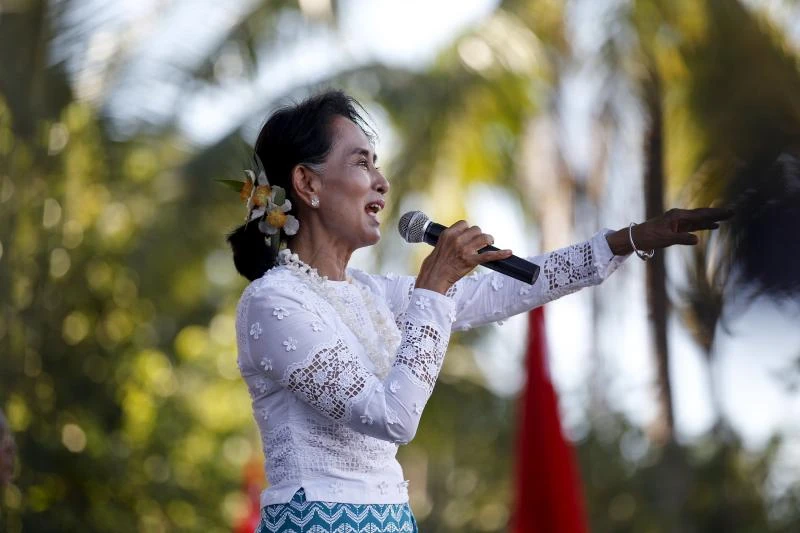
TAUNGGOTE, Myanmar: Aung San Suu Kyi addressed hundreds of supporters in Myanmar’s volatile Rakhine state Friday, flanked by the biggest security contingent seen so far in her election bid as she tours a region wracked with religious tension.
The opposition leader has mostly received a hero’s welcome in nationwide rallies ahead of the November 8 parliamentary polls, but her party is braced for a mixed reception in the western state of Rakhine, where some Buddhist hard-liners accuse her of sympathizing with maligned local Muslims.
Suu Kyi was separated from the cheering crowds by dozens of guards at a football ground in the remote rural town of Taunggote, where she called for economic development in the impoverished state.
“A few people here are rich but most are poor, this is not real development,” she told flag-waving supporters, promising more jobs in Rakhine if her National League for Democracy (NLD) comes to power next month.
Suu Kyi has opted to skirt state capital Sittwe and other more hair-trigger areas of the state, which remains deeply scarred by two bouts of communal unrest between Buddhists and Rohingya Muslims that erupted in 2012, leaving more than 200 dead.
While the democracy icon has faced international disappointment at her reluctance to speak out in support of the minority Rohingya, she is viewed with suspicion among Buddhist hard-liners who see her as supportive of Muslims.
During a recent interview with India Today Suu Kyi defended her reticence, saying “flaming words of condemnation” were the wrong way to achieve reconciliation.
Earlier Friday Muslim supporters lined up with flags to welcome her convoy as it wove through the tropical countryside from Thandwe town, the gateway to Myanmar’s most developed beach resorts some 70 km (45 miles) away.
But they were noticeably absent from her rally in Taunggote, where the mob killing of 10 Muslims in 2012, apparently in revenge for the rape and murder of a local Buddhist woman, helped spark the subsequent unrest.
Rakhine farmer Myo Myo Aung, who attended the rally, said Suu Kyi should not have to answer thorny questions like whether or not Rohingya Muslims should be called “Bengali” — a disparaging term because it suggests they are immigrants from neighboring Bangladesh.
Debates over this term were created “by people who want to cause trouble,” he said.
“I will vote for the NLD because I believe it will make a change. She has already suffered enough. We have already suffered enough,” the 30-year-old told AFP.
The veteran activist, who turned 70 this year, was locked up for a total of 15 years under house arrest by Myanmar’s former junta generals, who viewed her popularity as a threat to their iron-grip on power.
Most of the 140,000 people displaced as a result of Rakhine’s bloodshed and arson are Muslims.
They remain trapped in miserable camps or have attempted to escape on rickety boats in a desperate exodus from Myanmar that has swelled in recent years.
But both the Buddhist and Muslim communities are affected by deep hardship in Rakhine, one of Myanmar’s least developed regions.
Suu Kyi has accused her opponents of using religion — and the rise of a powerful nationalist monk-led movement — as part of their political campaigns.
But she has also faced accusations of bowing to religious hard-liners.
Her party has fielded no Muslim candidates for the November polls — part of a wider loss of political representation for a minority that makes up around five percent of the population.
Suu Kyi takes election bid to Myanmar’s strife-torn Rakhine