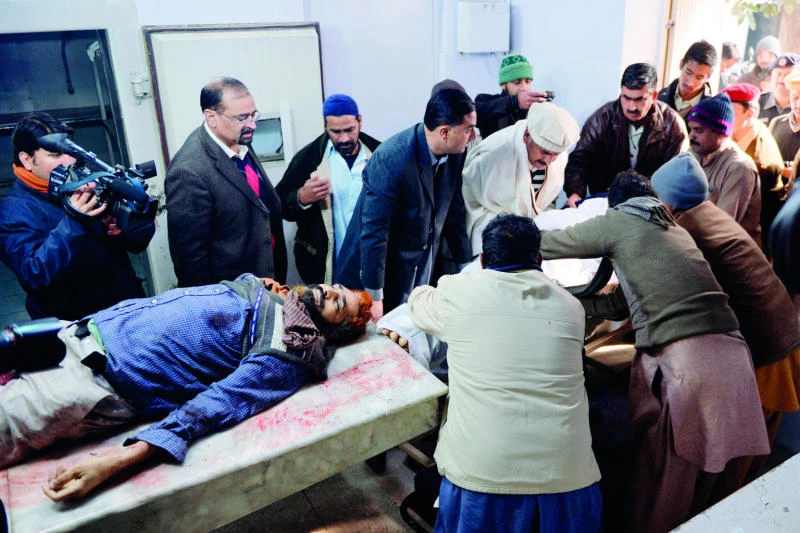
RAWALPINDI: A Taleban suicide bomber killed at least 13 people in a market next to Pakistan’s military headquarters on Monday, a day after one of the deadliest attacks on security forces in recent years.
A further 18 people were wounded in the blast which tore through RA bazaar in Rawalpindi, Islamabad’s twin city, only 15 meters (50 feet) from the army’s General Headquarters, at around 7.45 a.m. (0245 GMT).
It came a day after the Tehreek-e-Taleban Pakistan (TTP) killed 26 soldiers and wounded at least 25 others in a suicide bombing in the northwestern town of Bannu.
Two high-profile attacks in 24 hours mark a sharp upturn in violence from the TTP after a period of relative quiet following the death of their leader Hakimullah Mehsud in a US drone strike in November.
Haroon Joya, a senior police official at the scene of Monday’s blast, told reporters six soldiers and seven civilians had been killed.
“It was a suicide attack, we are collecting evidence from the spot. We have collected some body parts suspected to be of the suicide bomber,” he said.
Earlier, the top government official in Rawalpindi, Sajid Zafar Dall said 18 people were wounded in the blast.
“The attack occurred when children were going to school. Our initial assessment is that the bomber was possibly on a bicycle and he then approached the target on foot,” Dall said.
The blast left the market place a mess of twisted shutters and rubble, with pieces of human flesh scattered on the ground, a reporter said.
TTP spokesman Shahidullah Shahid claimed Monday’s attack as payback for a deadly military raid on a radical mosque in Islamabad in 2007.
“It was carried by one of our suicide bombers to take revenge for the Red Mosque massacre,” he said.
“We will continue our struggle against the secular system.” Eyewitnesses described the power of the explosion.
“I was reading a newspaper after opening my shop and all of a sudden I heard a big blast,” Liaqat Ali, a grocery shop owner near the site said.
“The intensity of the blast threw me off my chair. I rushed outside and saw smoke and smoke everywhere. I saw injured laying and screaming on ground.”
Police and commandos cordoned off the area as ambulances took wounded to a nearby military hospital.
Analysts said the Taleban’s ability to carry out two such high-profile attacks in quick succession raised fresh questions about Pakistan’s strategy for dealing with the homegrown militant threat.
The government of Prime Minister Nawaz Sharif has said it wants talks with the Taleban and received the backing of all major political parties for dialogue in September.
But so far little progress has been seen and terror attacks rose 20 percent in 2013, according to the independent Pakistan Institute for Peace Studies.
Retired brigadier Shaukat Qadir, a security analyst, said the militants were taking advantage of the government’s lack of policy direction.
“You can keep talking about talks but this is what will happen to your talks. The Taleban have stated it quite loud and clear,” he said.
The fact the TTP had struck in Rawalpindi, the very heart of Pakistan’s military establishment, carried significant symbolic value, he added.
In claiming the Bannu attack on Sunday, the TTP threatened to carry out more strikes, saying they wanted revenge for the deaths of Mehsud and deputy Waliur Rehman — both killed in US drone attacks.
But Shahid also said the group was “ready for meaningful negotiations” if the government halted US drone strikes and withdrew troops from the tribal areas along the Afghan border where Taleban and Al-Qaeda-linked militants have hideouts.
President defends
anti-terror record
Pakistan’s president said Monday it was unfair to question his country’s commitment to fighting terror at home and abroad, after Afghanistan hinted that Pakistani intelligence was behind a deadly restaurant attack.
President Mamnoon Hussain, who has a largely ceremonial role, said Pakistan wanted a peaceful and stable Afghanistan.
His comments came after Afghanistan’s National Security Council, which is chaired by President Hamid Karzai, said “without doubt foreign intelligence services beyond the border” were behind Friday’s suicide attack on a Kabul restaurant that killed 21 people.
“Beyond the border” is a phrase commonly used by Kabul to refer to neighboring Pakistan, which was the main supporter of the former Taleban regime in Afghanistan.
Afghan officials have long voiced suspicions about connections between the hard-line movement and Islamabad’s powerful intelligence services.
Speaking at the launch of a new book about Afghanistan by a Pakistani think-tank, Hussain insisted his country’s support for the fight against extremism was in earnest.
“Sometimes, our commitment is questioned. The reality is that, leaving aside Afghanistan, there is no other country in the world than Pakistan that has paid a higher price,” Hussain said, according to a statement released by his office.
“Pakistan stands for a peaceful, stable, united and prosperous Afghanistan. We have consistently maintained that the solution of Afghanistan lies within Afghanistan.”
Taleban suicide bomber kills 13 near Pakistan military HQ