KARACHI: Thousands of Pakistanis attended funerals yesterday for victims of a bombing that killed 48 people in Karachi, the latest in a series of devastating attacks ahead of elections.
The bomb exploded in Abbas Town as worshipers left mosques and ripped through two apartment blocks, setting one of them on fire and trapping people beneath piles of rubble. Survivors are being housed temporarily in schools.
It was the deadliest bombing in Karachi, Pakistan’s largest city and business hub, since at least 43 people died in an attack on worshipers in December 2009.
There has been no claim of responsibility. But suspicion will likely fall on banned extremist organization Lashkar-e-Jhangvi, which has claimed major attacks in the city of Quetta, and on the Pakistani Taleban.
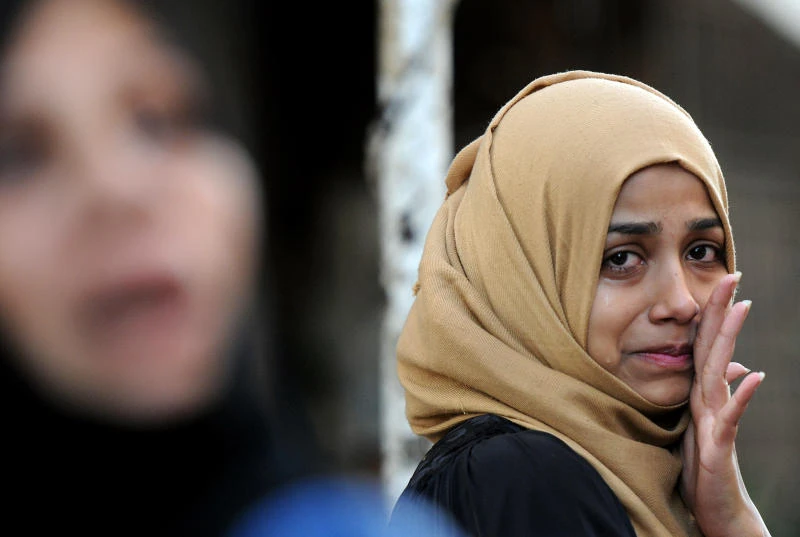
Thousands of men, women and children, many of them wearing black headbands, beat their chests and heads and sobbed as eight coffins passed by at the start of the first funeral, a reporter said.
Traffic was light as educational institutions, businesses and markets closed after the local government announced one day of mourning and Shiite groups three days of mourning for those killed in Sunday’s bombing.
At least 4,000 people turned out for the funerals, police officers estimated.
Karachi contributes 42 percent of Pakistan’s GDP but the city is plagued by sectarian, ethnic and political violence, which last year killed more than 2,200 people and which routinely forces business closures.
Rights groups have strongly criticized the government for failing to prevent sectarian murders and bombings or to bring to justice those responsible.
“Terrorists are killing us but the government is not taking any action to eliminate them,” said Mohsin Ali, 29, whose elder brother was killed.
“How long will we keep losing our children, our relatives?” Survivors could be seen searching for personal items and belongings such as jewelery from the rubble of their apartments.
“The government should provide us with arms to deal with terrorists if their agencies are unable to bring them to book,” said Azam Khan, who said he had taken several of the dead to hospital.
“We will vote for those who eliminate these terrorists. We are not ready to be hoodwinked by empty slogans any more.” Sindh provincial police surgeon Aslam Pechuho said the death toll had risen to 48 from an overnight 45, with around 200 wounded.
So far hospitals have released only 13 bodies for burial with the rest yet to be formally identified, officials said.
Pakistan’s parliament is due to dissolve in two weeks in preparation for elections. But rising violence against Shiites, who make up around 20 percent of the 180 million population, has raised serious questions about security.
“The unfortunate reality is that things could take a turn for the worse as tensions increase ahead of the approaching general elections,” The News newspaper wrote in an editorial yesterday.
Last year was the deadliest on record for Shiites in Pakistan with more than 400 killed, according to Human Rights Watch.
The Supreme Court ordered authorities to come up with a strategy to protect Shiites after bomb attacks in the southwest on Jan. 10 and Feb. 16 killed nearly 200 people.
Police on Feb. 22 detained Lashkar-e-Jhangvi leader Malik Ishaq for 30 days under a law intended to maintain public order.
He was also detained briefly last year for inciting sectarian hatred, having been released on bail in 2011 despite being implicated in dozens of murders.
The Pakistani Taleban have also increased attacks in recent months, leading to fears they could disrupt the election scheduled to take place by mid-May.