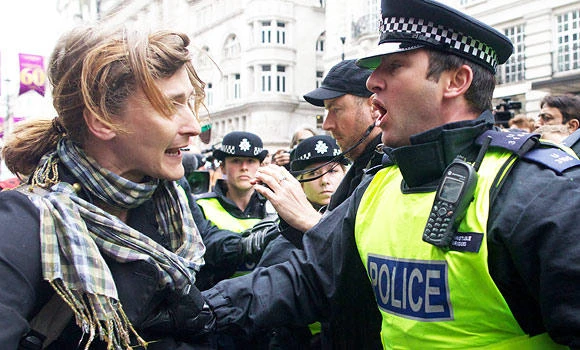
LONDON: Thousands of protesters took the streets of Belfast yesterday against the agenda of the G8 meeting. Protesters urged G8 leaders to act on global poverty at their upcoming summit, expected to be dominated by talks on Syria.
Around 5,000 people joined each of two demonstrations organized by trade unions and campaigners against global hunger ahead of the G8 summit in the province tomorrow and on Tuesday.
Northern Ireland, which still suffers from sporadic sectarian violence despite a peace deal in 1998, has organized its biggest-ever police operation for the talks, with 8,000 officers deployed.
They were split between Belfast and the luxury lakeside Lough Erne Resort where the G8 leaders will be staying, including US President Barack Obama and German Chancellor Angela Merkel.
Japanese Prime Minister Shinzo Abe left to attend the summit, where he hopes to shore up support for his bold policy of financial reforms dubbed “Abenomics”.
British Prime Minister David Cameron, who is hosting the summit, is pushing for agreement on his three G8 priorities of trade, tax and transparency.
There was progress late Friday toward what he has admitted would be the biggest prize of the summit — the start of formal negotiations between the European Union and the United States on a free trade agreement.
EU trade ministers finally thrashed out an agreement on how to negotiate for a deal, after meeting a French demand to exclude the key audiovisual sector.
But the Syrian conflict looks set to dominate the talks after Washington upped the ante by pledging military aid to fighter seeking to oust Bashar Assad.
The White House said for the first time on Thursday that the regime had used chemical weapons, notably sarin gas, on multiple occasions against the opposition — crossing what it has described as a red line. Cameron said he wanted G8 summits to “get back to a fireside chat” in which leaders sit together “without a lot of advisers and without a lot of communiques, addressing problems of the world that they want to do something about”.
“International gatherings are worthwhile, if they are done in the right way. The trouble is too many of them are about long communiques with endless textual arguments,” he told a UK newspaper.
Thousands join anti-G8 protest in Belfast