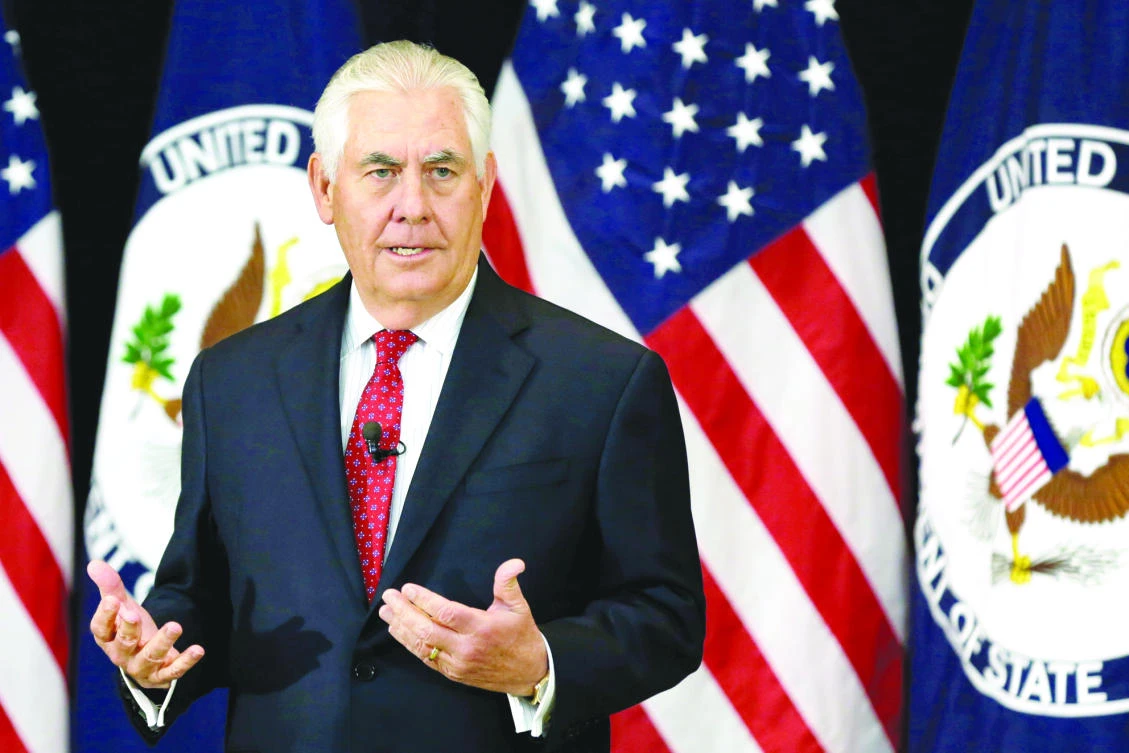
WASHINGTON: Translating “America First” into diplomatic policy, Secretary of State Rex Tillerson has proclaimed that the US can’t always afford to condition its foreign relationships and national security imperatives on countries adopting American values like human rights.
Appearing before State Department employees anxious about changing priorities, Tillerson on Wednesday steered clear of giving details about the 2,300 jobs he plans to eliminate or how his proposed cut of roughly a quarter of the department’s budget will affect agency operations and programs.
But he acknowledged widespread unease about the forthcoming changes and pledged that diplomats would emerge from the department’s changes with “a much more satisfying, fulfilling career.”
Yet even as he left key administrative questions unanswered, Tillerson offered the most extensive elaboration to date of the meaning of President Donald Trump’s “America First” mantra, adopted during the presidential campaign and taken to the White House. Over the last two decades, he said, Washington had “lost track” of whether post-Cold War alliances were still serving US interests.
The former Exxon Mobil CEO distinguished between US “values,” which he described as enduring, and “policies,” which Tillerson said must adapt to the times.
“In some circumstances, if you condition our national security efforts on someone adopting our values, we probably can’t achieve our national security goals,” Tillerson said. “It really creates obstacles to our ability to advance our national security interests, our economic interests.”
Still, he insisted the US won’t abandon core values. In some instances, Tillerson said, the US should and will require other nations to adopt “certain actions as to how they treat people” if they want to cooperate with the US In other instances, he said the US would continue advocating for its values without using them as leverage.
“It doesn’t mean that we leave those values on the sidelines,” Tillerson said. “It doesn’t mean that we don’t advocate for and aspire to freedom, human dignity, and the treatment of people the world over.”
Rights groups and lawmakers from both parties have raised concerns about the administration de-emphasizing human rights, pointing to Trump’s warm interactions with leaders of nations like the Philippines and Egypt, which have experienced democratic backsliding in recent years. Tillerson’s remarks reinforced the notion that under Trump, the US is willing to cut deals and cooperate closely with governments failing to improve their rights records.
Tillerson’s address came as he prepares a massive reorganization and downsizing that has fueled Democratic and Republican fears that the administration is downgrading the importance of aid and diplomacy. Even as Tillerson proposes a 26 percent cut to the budget, Trump is pressing for a major funding boost to the Pentagon and has already secured billions of dollars in new military funding from Congress.
Tillerson said there was “nothing easy” about what he is trying to do, conceding that the overhaul would present major disruptions for diplomats and their families who serve in posts worldwide. He asked employees to provide input — through a survey and other methods — to help shape the agency’s future direction. The State Department employs about 75,000 people globally.
“I can promise you that when this is all done, you’re going to have a much more satisfying, fulfilling career,” Tillerson said. “Because you’re going to feel better about what you’re doing.”
Appearing before State Department employees anxious about changing priorities, Tillerson on Wednesday steered clear of giving details about the 2,300 jobs he plans to eliminate or how his proposed cut of roughly a quarter of the department’s budget will affect agency operations and programs.
But he acknowledged widespread unease about the forthcoming changes and pledged that diplomats would emerge from the department’s changes with “a much more satisfying, fulfilling career.”
Yet even as he left key administrative questions unanswered, Tillerson offered the most extensive elaboration to date of the meaning of President Donald Trump’s “America First” mantra, adopted during the presidential campaign and taken to the White House. Over the last two decades, he said, Washington had “lost track” of whether post-Cold War alliances were still serving US interests.
The former Exxon Mobil CEO distinguished between US “values,” which he described as enduring, and “policies,” which Tillerson said must adapt to the times.
“In some circumstances, if you condition our national security efforts on someone adopting our values, we probably can’t achieve our national security goals,” Tillerson said. “It really creates obstacles to our ability to advance our national security interests, our economic interests.”
Still, he insisted the US won’t abandon core values. In some instances, Tillerson said, the US should and will require other nations to adopt “certain actions as to how they treat people” if they want to cooperate with the US In other instances, he said the US would continue advocating for its values without using them as leverage.
“It doesn’t mean that we leave those values on the sidelines,” Tillerson said. “It doesn’t mean that we don’t advocate for and aspire to freedom, human dignity, and the treatment of people the world over.”
Rights groups and lawmakers from both parties have raised concerns about the administration de-emphasizing human rights, pointing to Trump’s warm interactions with leaders of nations like the Philippines and Egypt, which have experienced democratic backsliding in recent years. Tillerson’s remarks reinforced the notion that under Trump, the US is willing to cut deals and cooperate closely with governments failing to improve their rights records.
Tillerson’s address came as he prepares a massive reorganization and downsizing that has fueled Democratic and Republican fears that the administration is downgrading the importance of aid and diplomacy. Even as Tillerson proposes a 26 percent cut to the budget, Trump is pressing for a major funding boost to the Pentagon and has already secured billions of dollars in new military funding from Congress.
Tillerson said there was “nothing easy” about what he is trying to do, conceding that the overhaul would present major disruptions for diplomats and their families who serve in posts worldwide. He asked employees to provide input — through a survey and other methods — to help shape the agency’s future direction. The State Department employs about 75,000 people globally.
“I can promise you that when this is all done, you’re going to have a much more satisfying, fulfilling career,” Tillerson said. “Because you’re going to feel better about what you’re doing.”