GENEVA: A UN envoy met members Syria’s opposition Geneva on Thursday as efforts began to salvage peace talks by focusing on local cease-fires and prisoner swaps rather than a political deal.
The first day of talks on Wednesday was dominated by fierce rhetoric from President Bashar Assad’s government and its foes. Brought together for the first time in almost three years of war, each accused the other of atrocities and showed no sign of compromise.
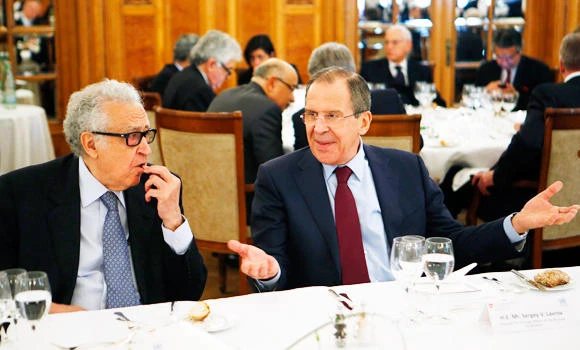
UN envoy Lakhdar Brahimi met leaders of the Syrian opposition at a Geneva hotel to discuss the agenda for further talks on Friday. The opposition then went to meet officials from the United States, France and Britain. Brahimi was due to meet the delegation from Assad’s government later on Thursday.
Officials still hope they can salvage the process by starting with more modest, practical measures to ease the plight of millions of people on the ground, especially in areas cut off from international aid.
More than 130,000 people are believed to have been killed, nearly a third of Syria’s 22 million people have been driven from their homes and half are in need of international aid, including hundreds of thousands in areas cut off by fighting.
Wednesday’s opening ceremony saw global powers vigorously defend their sides, with Western countries, Arab states and Turkey all joining the opposition in demanding a transitional government that would exclude Assad.
Russia, his main global supporter, said the focus of talks should be on fighting “terrorism,” a word the Syrian government applies to all of its armed opponents.
In the most dramatic moment of the conference, Assad’s foreign minister accused opposition fighters of raping dead women, killing foetuses and eating human organs, drawing a rebuke from UN Secretary-General Ban Ki-moon for using inflammatory language.
Foreign Minister Walid Al-Moualem also dismissed any suggestion that Assad might leave power, saying no international forum had the right to question the president’s legitimacy. Western and Arab states declared Assad must go.
The main negotiations, expected to last up to a week, are not due to begin until Friday, giving mediators a day to lower the temperature and focus on pragmatic steps.
One of the opposition negotiators, Haitham Al-Maleh, said the mood was positive despite the tough first day. He spoke of a two-stage process, with practical steps like prisoner swaps, cease-fires, the withdrawal of heavy weapons and setting up aid corridors being dealt with first, before the political future.
UN envoy meets Syria foes to salvage talks after bitter start