ABOARD USS GEORGE WASHINGTON, Philippines: US Navy helicopters and planes Friday launched non-stop aid flights to desperate survivors of a super typhoon in the Philippines that killed thousands, igniting a global relief effort criticized for being too slow.
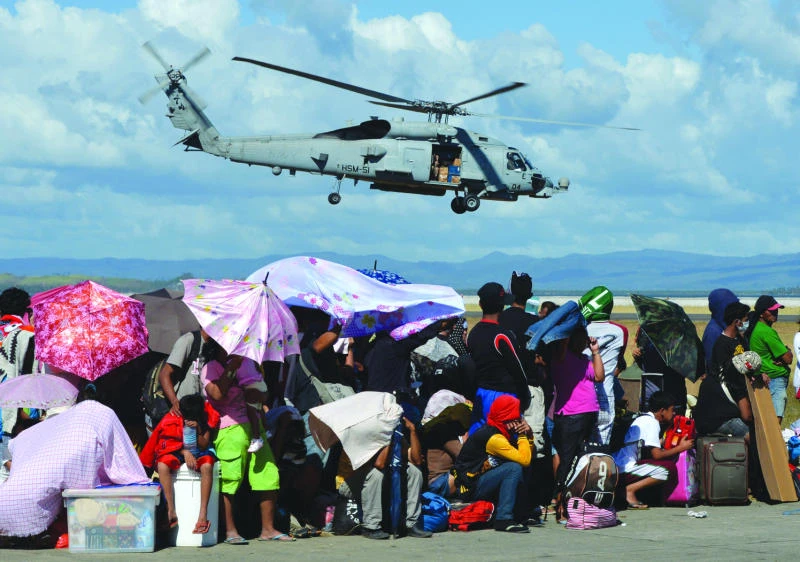
On the USS George Washington a continuous stream of helicopters landed and took off from the huge carrier as they shuttled supplies to the devastated city of Tacloban and remote villages.
Amid the roar of aircraft sailors bustled to load boxes of food and other relief goods onto helicopters, as enormous volumes of water were desalinated before being sent to the thirsty and famished victims of last week’s typhoon.
“The USS George Washington is delivering water, medical supplies and hygienic supplies” to towns worst hit by Super Typhoon Haiyan,” US Seventh Fleet spokesman Lt. David Levy said in a statement.
Twenty US Navy helicopters were in “continuous operation,” he added, saying some had been evacuating wounded and destitute survivors from remote areas devastated when the Category Five storm hit, packing brutal winds that generated tsunami-like waves.
The United Nations said almost 4,500 had been confirmed killed in the typhoon — one of the strongest ever recorded — and the lives of many others were hanging by the thinnest of threads, even as the relief operations moved up a gear.
The Philippines’ disaster agency upped their toll to 3,621 as the government and the UN continued to disagree over the count.
In Tacloban city’s only functioning hospital — without a roof, power or water — a woman frantically pumped air into the lungs of her husband, lying critically ill a day after his leg was amputated.
Valentina Gamba, the head of nursing at the hospital, said they had tried to discharge patients who they could not feed.
“But they still stayed for shelter... because they cannot go home,” Gamba told AFP.
Several kilometers away at the city’s airport, hundreds of famished and homeless survivors hoping to escape stricken Leyte island looked on as American soldiers unloaded aid from aircraft onto trucks.
Emergency supplies have been excruciatingly slow to get through to increasingly desperate survivors, with United Nations humanitarian chief Valerie Amos admitting that the delivery of relief goods had not been quick enough.
The USS George Washington Strike Group — with 5,000 sailors on the huge carrier alone, and seven other ships — arrived on Thursday with badly needed equipment, manpower and expertise, giving some hope that the delivery of aid would speed up.
Ships and planes from Asia-Pacific nations and Europe are converging on the Philippines, bearing food, water, medical supplies, tents and other essentials.
Prime Minister David Cameron dispatched the biggest vessel in Britain’s own fleet, a helicopter carrier, while heavy transport planes carrying equipment such as forklift trucks have already arrived.
China has upped its aid contribution after its initial offer of $100,000 was widely criticized, and its state media increased the pressure on Beijing Friday, urging it to join other countries in deploying warships.
At Tacloban airport US aircraft were coming in two at a time. American servicemen were driving trucks loaded with aid and appeared to be acting quasi-independently, with a large part of the airfield to themselves.
On Tacloban’s streets, the sense of want is gnawing for a population in dire need of the basics of life.
While the retrieval of the dead continues, there are growing fears for the health of those who survived.
The World Health Organization says there are significant injuries that need to be dealt with — open wounds that can easily become infected in the sweltering tropical heat.
Experts warn that a reliable supply of clean drinking water is vital if survivors are to avoid diarrhea, which can lead to dehydration and death, especially in small children.
US carrier spearheads Philippine relief effort