- No 'cost-free US withdrawal' for Taliban, notes the think tank
- Social cohesion and political stability will be threatened in regions as far as Europe, says the report
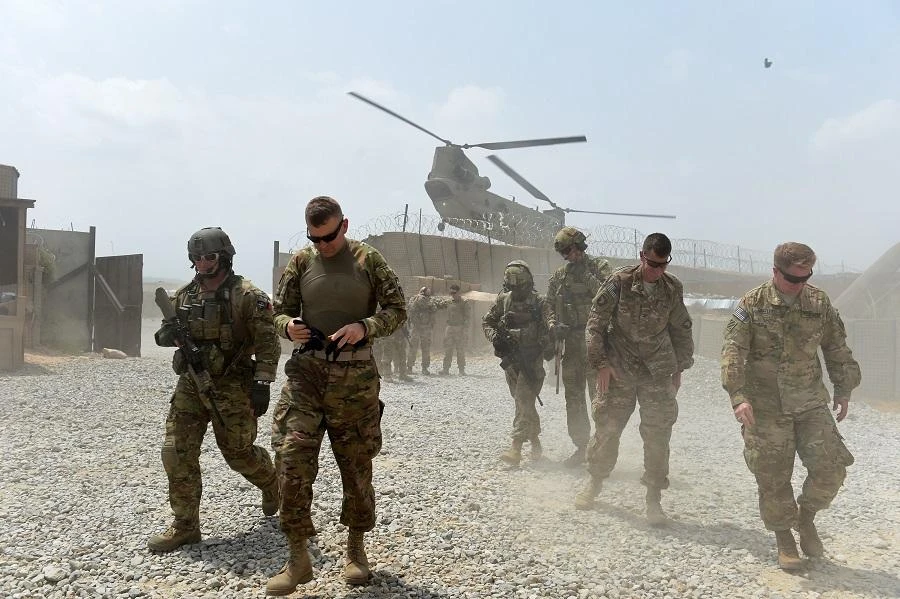
ISLAMABAD: The Taliban will lose interest in negotiating a peace deal in Afghanistan if the US withdraws its troops from the country, a US report titled “Consequences of a Precipitous US Withdrawal from Afghanistan” warned.
“If Taliban leaders receive or come to expect a cost-free US withdrawal, they will have little incentive to bargain with the United States or with the US-backed Afghan government,” reads the report.
The report — written for the RAND Corporation, a US think-tank specializing in defense affairs and co-authored by two former US special envoys for Afghanistan and two former defense officials — instead pushed for the Taliban to be persuaded of two things: first, that US forces will leave if there is a peace deal and, second, that they will stay if there is not.
“President Trump’s latest move tends to confirm the first while fatally undercutting the second,” it laments.
Urging the president to take into consideration twelve main factors before considering a withdrawal, the report further argued that neighboring countries, including Pakistan, Russia, Iran, India and Uzbekistan have a history of backing various ethnic groups, such as the Pashtuns, Tajik, Uzbek, and Hazara.
“This will lead regional power brokers to transfer fighters from the Afghan army into regional militias, establish control over police and other institutions, and divert local sources of government revenue for their own use,” the report warns, adding that the withdrawal will do both, undermine the US backed government in Kabul and further weaken the Afghan economy.
Touching upon the vacuum that will form due to a premature withdrawal and inter-communal violence sparked by countries backing specific ethnic groups, the report predicts that extremist groups, including Al Qaeda and the Islamic State, will likely be able to claim space to regain control, recruit and even plan far flung attacks, sucking Afghanistan back into wider civil war.
“If the United States loses the capacity to contribute to suppressing these groups within Afghanistan, and if it cannot rely on a trusted indigenous partner, the pressure on terrorist groups will be reduced, allowing them more time, space, and resources to organize far-flung attacks.”
Noting that, “Since 2001, Russia and Iran have generally supported the Kabul government but, in recent years, have provided limited aid to the Taliban as a hedge,” the authors fear, “These relationships will likely be reinforced as the central government’s financial base collapses, its writ weakens, and its cohesion erodes”
The authors of the report further urged that despite Pakistan having repeatedly rejected these claims, it “has long tolerated and facilitated use of its territory by the Taliban”. And in the event of a precipitous US withdrawal, they fear, “Pakistan will likely become more open in its backing.”
Pointing out that other NATO forces will also leave, the authors wrote “NATO force levels will accordingly follow US numbers downward, eventually leaving vast areas of the country and elements of the Afghan army and police without expert training, advice, and other forms of support.”
The report predicts all these factors will lead to a sharp rise in civilian death, and an increase in refugee flows. “As the security situation in Afghanistan worsens, these numbers [civilian casualties] could rise dramatically, further threatening social cohesion and political stability in regions as far as Europe,” the report cautioned.