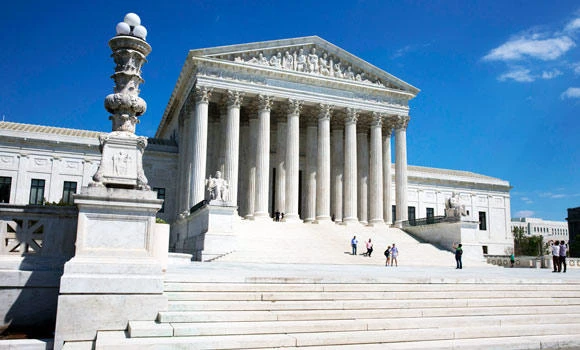
WASHINGTON: The US Supreme Court blocked a new voter identification law in Wisconsin from going into effect.
The nine-justice court, with three conservative members dissenting, granted a last-minute request by civil rights groups seeking to block an appeals court ruling that the law could be implemented.
The ruling comes on the same day a federal judge struck down a Texas law requiring voters to show identification at polls, saying it placed an unconstitutional burden on voters and discriminated against minorities.
The Supreme Court’s action means the Wisconsin law, which requires voters to present photo identification when they cast ballots, will not be in effect in the lead-up to the November elections.
“Today’s order puts the brakes on the last-minute disruption and voter chaos created by this law going into effect so close to the election,” Dale Ho, director of the American Civil Liberties Union Voting Rights Project, said in a statement.
The ACLU and other groups said the law would sow confusion at the polls and reduce votes.
Justice Samuel Alito wrote a brief dissenting opinion, which was joined by fellow conservatives Antonin Scalia and Clarence Thomas.
He wrote that although it was “particularly troubling” that absentee ballots had been sent out before the November election without notifying voters of the identification requirements, there was still no legal justification for blocking the law.
Wisconsin Attorney General J.B. Van Hollen said in a statement he would explore alternatives to address the court’s concerns regarding absentee ballots.
“I believe the voter ID law is constitutional, and nothing in the Court’s order suggests otherwise,” he said.
Wisconsin’s is one of several similar voter ID rules that have become a political and racial flashpoint across the United States. Wisconsin and other states have argued they need such rules to prevent voter fraud.
US Supreme Court blocks Wisconsin voter ID law