CARACAS: Venezuelan President Nicolas Maduro called for a meeting of South American leaders over the growing turmoil facing his country, where the death toll from a month of anti-government protests hit 20.
Ahead of the meeting, due to take place next week in Chile, Maduro blamed the month-old unrest shaking his oil-rich country on a minority sector of the opposition.
“It’s a tiny group belonging to the opposition and they have put the rest of the opposition in a dire situation,” Maduro told CNN in an interview.
UN human rights experts demanded answers Thursday from Venezuela’s government about the use of violence and imprisonment in a crackdown on widespread demonstrations. The six experts, who report to the UN’s top human rights body in Geneva, wrote the administration of President Maduro about allegations of protesters being beaten and in some cases severely tortured by security forces, and taken to military facilities, cut off from communication and denied legal help, UN officials said.
Venezuela’s UN Mission in Geneva called it part of an international disinformation campaign to undermine the government.
In Washington, the permanent council of the Organization of American States met into the early hours of Friday to discuss the situation in Venezuela, without making any decision. It was to resume deliberations later in the day.
Maduro’s call for regional dialogue on his country’s unrest came a day after he broke off relations with Panama, following its call for the rival OAS to convene on the crisis.
Maduro’s government later ordered Panamanian Ambassador Pedro Pereira and three other diplomats working at the mission to leave the country within 48 hours, Panama’s Deputy Foreign Minister Mayra Arosemena told reporters.
Last month, Venezuela expelled three US diplomats, accusing them of conspiring with the opposition, a claim that Washington denied.
Foreign Minister Elias Jaua said Venezuela also had suspended debt negotiations over $1 billion owed to Panamanian exporters.
He also called for improved relations between Venezuela and the United States. The two have been without ambassadors in each other’s countries’ since 2010, and Maduro has accused Washington of encouraging the daily street protests.
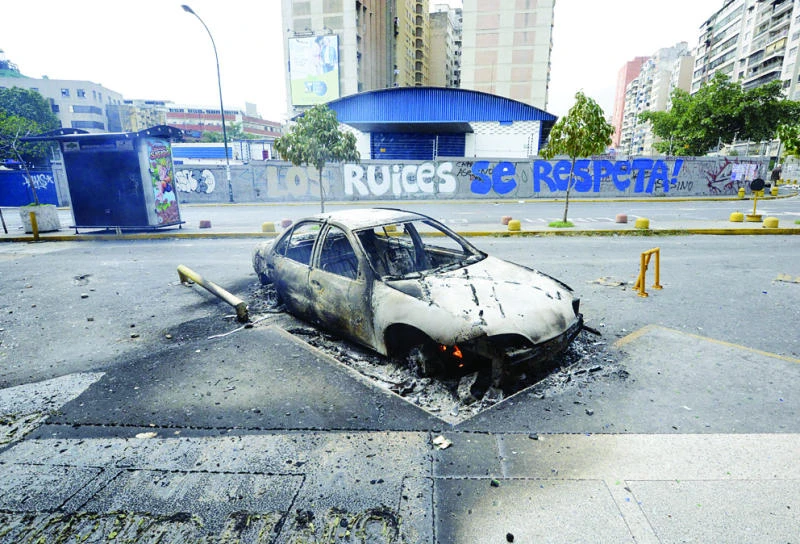
The National Guard member and the civilian were killed Thursday after a group of men on motorcycles rode into an east Caracas neighborhood to remove a street barricade erected by anti-government protesters.
The clash that erupted in the mixed industrial and residential district of Los Ruices heightened tensions on the same day the Venezuelan government expelled foreign diplomats for the second time in a month.
More than 100 men on motorcycles carrying pipes and rocks swarmed Los Ruices in the incident. Some tried to force their way into buildings. Residents screamed “murderers, murderers” from rooftops and the motorcyclists taunted them from below, urging them to come down and fight.
In other neighborhoods, motorcyclists dismantled barricades under the whistles and shouts of residents, but without violence.
Venezuelans fed up with food shortages and unchecked violence have been staging nearly daily street protests since mid-February, snarling traffic with barricades of garbage, furniture and burning tires. At least 21 people have been killed in related violence, by government count, in the country’s worst unrest in years.
President Nicolas Maduro’s administration shows no signs of crumbling from several weeks of nearly daily demonstrations, but the country appears in a stalemate. Protesters are mostly from the middle and upper classes although they do include poorer Venezuelans who don’t protest in their home districts for fear of pro-government paramilitaries.
Sucre Mayor Carlos Ocariz said residents of Los Ruices reported hearing gunshots after motorcyclists began dismantling the barricades. Some apartment dwellers began banging pots and raining down bottles to express their anger, he said. In the melee, a 24-year-old motorcycle taxi driver was shot dead.
“I’m not going to be irresponsible and accuse anyone,” Ocariz said. “I condemn the violence and the shots must be investigated, but I also reject the brutal repression” of security forces.
When National Guardsmen arrived to secure the area, a 25-year-old sergeant was shot through the neck and killed. Ocariz said that according to district police, who report to him, in both cases the men’s wounds seemed to indicate the shots came from above.
Pro-government motorcyclists who reside in slums served as street-level enforcers for the late President Hugo Chavez and continue to menace opponents of the ruling socialists. The opposition claims they are bankrolled by the government.
Maduro, meeting with US actor Danny Glover, said on state TV that the slain motorcyclist, Jose Gregorio Amaris, used his motorcycle as a taxi and was clearing debris in order to do his job.
He called those who build street barricades “vandals who hate the people” and said a second motorcyclist was seriously injured.
Among opposition demands is that the government disarm the motorcycle-riding paramilitaries, called “colectivos.”
In the latest development affecting what the opposition calls a full-scale government assault on freedom of expression, a newspaper critical of the government said it was the target of a criminal defamation suit filed by National Assembly President Diosdado Cabello.
Venezuela looks to S. American leaders as protest toll hits 20