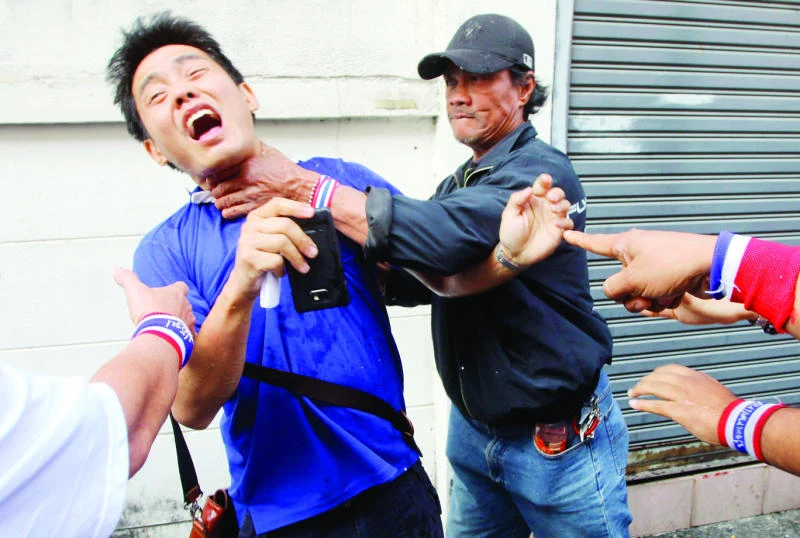
BANGKOK: A Thai protest leader was shot dead on Sunday as fellow demonstrators besieged polling stations in Bangkok, disrupting advance voting for hundreds of thousands of people before next weekend’s controversial general election.
Protesters descended on scores of polling stations in the Thai capital and several southern provinces, stopping ballot officials from entering and prompting election authorities to shut more than 80 venues nationwide.
More than two million people had been registered to vote before the Feb. 2 election, which was called by Prime Minister Yingluck Shinawatra to try to calm rising tensions after weeks of mass anti-government protests.
Around 440,000 of them nationwide were prevented from voting, said Somchai Srisutthiyakorn of the Election Commission, warning that “a similar problem” could afflict next Sunday’s poll.
Advance voting is routinely offered for those who cannot cast their ballot on polling day. But Sunday’s exercise was seen as a test of the prospects of holding the general election.
As the advance polls closed on Sunday afternoon a leader of the anti-government rallies was gunned down while he gave a speech from the back of a pick-up truck in the Bangkok suburb of Bang Na.
Nine other people were injured in the shooting, according to the city’s Erawan emergency center, with the violence deepening doubts over whether next weekend’s ballot can go ahead.
Protest spokesman Akanat Promphan accused a “pro-government mob” of carrying out the attack which killed Suthin Tharathin — the tenth victim of political violence in nearly three months of street rallies.
Police later said he died when a group of “Red Shirts” — government-supporting activists — from a neighboring province a few kilometers away clashed with protesters.
Each side in the bitterly divided kingdom routinely blames the other for the violence, but the incident will renew fears of wider clashes despite the imposition of a state of emergency across Bangkok.
“Forty-five polling stations had to be closed out of 50 in Bangkok,” said Surapong Tovichakchaikul, deputy prime minister and one of the main figures at the Center for Maintaining Peace and Order, which is handling the crisis.
Away from the capital voting went ahead in 66 of the country’s 76 provinces, including the ruling party’s heartlands in the north and northeast, he said.
Violence, protests blight advance voting for Thai poll