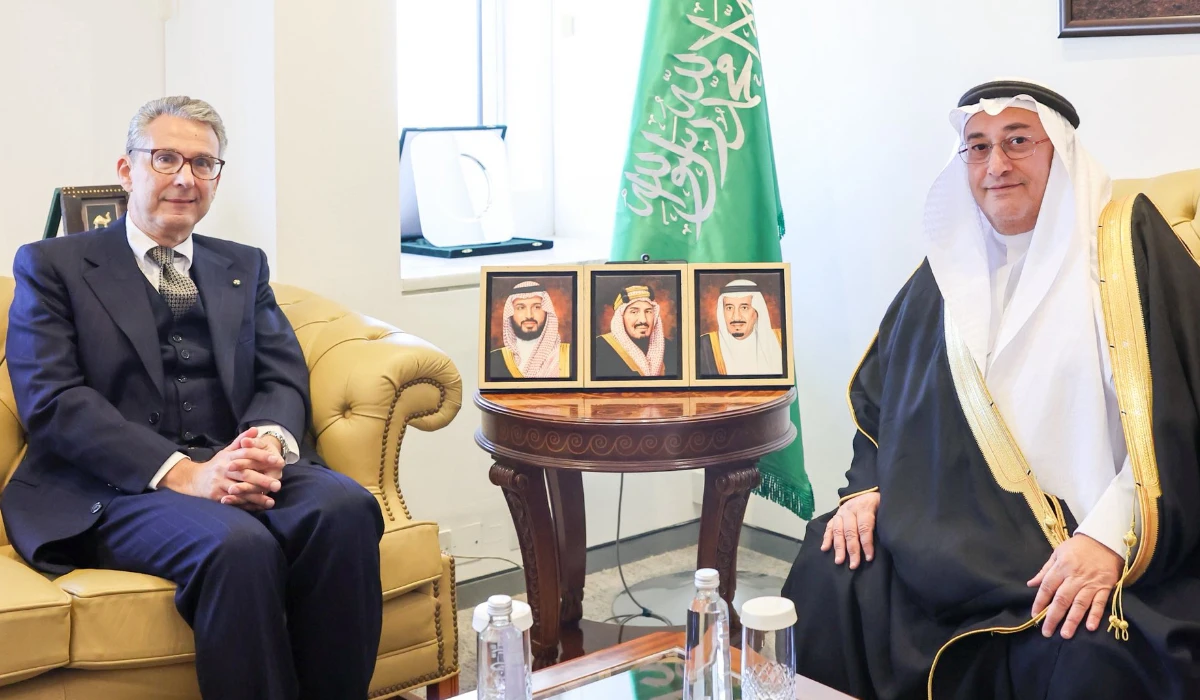
RIYADH, 31 August — The OPEC Fund for International Development has allocated a substantial sum to provide specialized treatment to a number of Palestinians seriously wounded in the latest Israeli aggression in the West Bank and Gaza Strip. The Kingdom, which contributes 35 percent of the fund’s resources, will be the largest financial partner in this initiative. The grant comes in the wake of the recent escalation of violence in the Palestinian territories, which left many dead or wounded.
"The selection of the most critical cases from amongst the wounded Palestinians was made by the Palestinian Ministry of Health in coordination with the hospitals of the West Bank and Gaza Strip," said Dr. Y. Sayyid Abdulai, director general of the OPEC Fund.
Abdelkader Benamara, OPEC Fund’s director of information and economic services, was also present during the interview.
Dr. Abdulai expressed condolences over the recent death of Dr. Mahsoun Jalal, Saudi representative on the OPEC Fund’s governing board.
He spoke about the growing responsibility of the fund in helping poor countries across the world. The intergovernmental organization, which seeks to promote cooperation between member states of the OPEC and other developing countries by providing financial aid for economic and social development, has a ministerial council as its supreme authority to govern its affairs. Minister of Finance and National Economy Dr. Ibrahim Al-Assaf currently represents the Kingdom at the council’s board.
Dr. Abdulai said the grant to the Palestinians would cover transportation costs of the patient and one family member, hospitalization, accommodation and a living allowance for two months. So far, a total of SR1.5 million has been allocated by the fund for the treatment of 109 Palestinians.
He pointed out that this intergovernmental body has so far made available a sum of SR22.5 billion for the implementation of 950 projects in 109 countries.
These projects, he said, are mainly in the priority areas identified by the OPEC Fund, like education, agriculture, transport, telecommunication, banking, health care and water. This is in addition to a number of projects in the private sector.
"Forty-six countries in Africa received 507 loans from the fund while 243 loans were given to 27 Asian countries. This represents a major portion of the fund’s disbursements," said Dr. Abdulai.
A pilot scheme aimed at reviving Bosnia-Herzegovina’s ailing livestock industry has also received support from the fund recently in the form of a SR19 million loan. The Bosnia project, he pointed out, aims to promote the growth of sustainable, small scale livestock production in a number of traditional farming communities and will benefit over 20,000 households. Of late, the fund has extended assistance worth SR53 million to fight the spread of HIV/AIDS on a global level.