
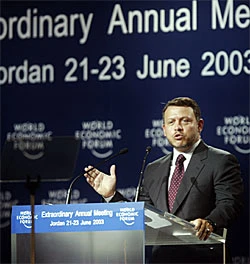
SHUNEH, Jordan, 22 June 2003 — A World Economic Forum (WEF) meeting focusing on Mideast economic development and reforms opened here yesterday with calls by King Abdallah for peace in the Middle East and reconstruction in Iraq to get under way quickly. The king said people were thirsty for stability.
Senior Arab officials were among the 1,200 participants from 65 countries.
“Extremists have tried to derail the peace process,” Abdallah told an audience of hundreds of world leaders. “When we hear this news we must remember what the vast majority on both sides want. They want peace ... these are the voices that count,” he said at the opening of the three-day meeting.
The king said he hoped the forum would build on resolutions made by the Israeli and Palestinian prime ministers at a summit in Aqaba, Jordan, on June 4, when they pledged to implement the international road map for peace. The international Middle East peace Quartet which drafted the initiative met on the sidelines of the WEF to plan the next steps for the implementation of the blueprint which foresees a Palestinian state by 2005. Through the meeting, Abdallah said, the WEF “is playing in an historic period of change”. He also expected WEF members to contribute to “promoting the reconstruction of Iraq”, which he said should “respect the rights of its people to determine their own future”.
Before the meeting Abdallah met the US overseer in Iraq, Paul Bremer, and told him the United States must “work rapidly to provide the Iraqi people with security and stability and honorable and adequate living conditions”. Bremer’s presence will be his first encounter with the world community and with Arab leaders who still feel uneasy about the occupation of Iraq, despite UN resolutions legitimizing it.
Over the next three days many sessions will be devoted to Iraq, which will be debated with the participation of Bremer and leading Iraqi politician Adnan Pachachi.
WEF President Klaus Schwab said he organized the summit because “the world and, above all, the region were in an urgent need of healing processes”.
“A global reconciliation summit, bringing together all the stakeholders of the global community could be an important step to re-establish mutual trust,” said Schwab.
“We have to seize the historic occasion given to us today, a window of opportunity for peace in the region, an opportunity for cooperation in the fight against terrorism everywhere, an opportunity for the expansion of international and regional trade, which history has shown is a powerful catalyst for peace and understanding among people,” he said.
German Foreign Minister Joschka Fischer during the panel discussion welcomed America’s return to lead Mideast peace efforts, but warned of a lack of political will and confidence between Israel and the Palestinian Authority.
Fischer said Europe had “called on the US for the past two years to go back in the “driver’s seat.” “We are happy now and we really would like negotiations to resume,” Fischer said as 1,600 business and political leaders from around the world gathered for the forum. The German minister warned against the lack of political will and confidence between Israel and the Palestinians.
WEF senior Managing Director Jose Maria Figueres earlier told AFP he hoped the “spirit of reconciliation” sought by the summit would contribute to establishing peace in the troubled region.
The venue chosen for the summit is highly symbolic: The shores of the Dead Sea face the Israeli-occupied Palestinian territories and the Dead Sea is the lowest point on the surface of the planet at 415 meters (1,366 feet) below sea level.
The summit will launch five “initiatives” for peace and development in the Middle East, including one to empower women, one to promote better understanding between Islam and the West and an Arab Business Council.
A Gulf businessman told Arab News that such conferences contribute to increased economic activity and exchange of know-how. He said the majority of participants agreed that urgent reforms are needed in the Mideast region.
— Additional input by agencies