
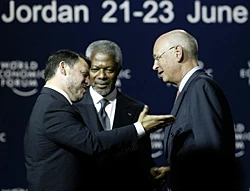
SHUNEH, Jordan, 24 June 2003 — The World Economic Forum in Jordan drew to a close yesterday with Arab businessmen and investors in the Middle East announcing the establishment of an Arab business council. The council, which consists of 50 leading businessmen and investors, will take steps to consolidate cooperation between the members in the Arab countries’ private sectors, and to strengthen the ability of Arab countries to compete in the international market.
The executive director, Shafeeq Jaber, said: “We decided to establish the council to meet the challenges we face. We want to work with our governments to strengthen our ability to compete and for the region to play a leading role at the international level.” The announcement came amid US calls for free trade between the United States and the Middle East.
Underscoring proposals by President George W. Bush for a free trade zone linking the US with the Mideast, US Trade Representative Robert Zoellick called on Mideast countries to leave behind “military conflicts and misguided economic policies.”
He said exports and investment in the region had declined because of the unstable situation. Citing as an example a recent free trade agreement between Jordan and the US, which has seen Jordanian exports to the US soar manifold, Zoellick said he wanted the whole region to benefit from such deals. He said negotiations were underway to seal similar agreements with Morocco and Bahrain. International experts and officials were to tackle more than 20 themes from building information technology industries, developing tourism, Arab banking, water management and attracting investments.
“The Middle East is ripe with business opportunities. But the lack of infrastructure has either hindered or constrained the development of several industries that could be significant growth engines for the region,” a statement by the WEF said.
Ways of bolstering tourism were also being discussed. According to estimates the Middle East accounts for “only two percent of global tourist arrivals and revenues” despite being seen as the cradle of civilizations.
Women also had their day with a session devoted to ways of empowering them, securing roles for them in the private sector and what steps their governments can take to improve their conditions.
The Israeli-Palestinian road map was also an important topic, but efforts to bridge the gap between the two sides appeared deadlocked at the end of the three-day forum.
UN Secretary General Kofi called for more Iraqi involvement in post-war construction, saying the Iraqi people had an “unquestionable right” to determine their own political future and control their own natural resources. Also yesterday, US Secretary of State Colin Powell told Jordanian state television that Washington’s overseer in Baghdad planned on setting up a political committee in post-war Iraq in July.
“Ambassador Bremer ... was here yesterday and spoke to the assembled delegates and talked about the desire to put in place a political committee sometime in July,” Powell said about US plans for Iraq.
The committee, he said, will consist “of Iraqi citizens and leaders who will begin the process of taking over responsibility and begin the process of staffing the ministries”. US officials said at the beginning of June they would install an interim 25-30 member Iraqi political council within six weeks that would appoint ministers in waiting.
Powell also told Jordanian television the US-led administration in Baghdad was sending an Iraqi delegation to New York for a donors’ conference on the war-battered country’s reconstruction.
“And as soon as possible we want to transfer to a new Iraqi government responsibility for their own country and their own future,” Powell added in an interview conducted on the sidelines of the forum.
— Additional input from agencies