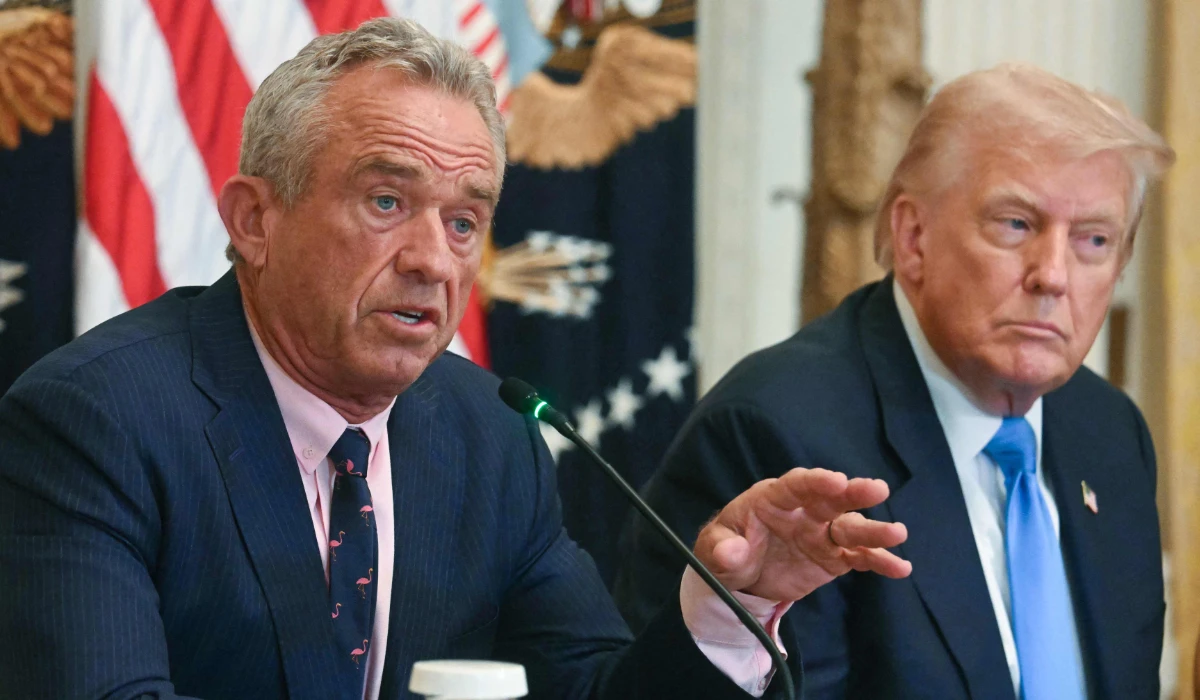
CAMP DAVID, Maryland, 25 June 2003 — US President George W. Bush yesterday proposed a $3 billion aid package and announced a trade pact to reward Pakistan for its help in the US-led war on terrorism but did not offer the fighter jets long sought by Islamabad.
“Greater economic development is ... critical to fulfilling the hopes of the Pakistani people,” Bush told a press conference with President Pervez Musharraf at the Camp David presidential retreat in the Maryland mountains.
Bush praised Musharraf’s leadership in fighting Al-Qaeda and in helping ease tensions with India over the disputed Kashmir region while saying that Musharraf’s vision of progress at home will “require movement toward democracy in Pakistan.”
“I’m hopeful that the two countries will deepen their engagement on all issues, including Kashmir,” Bush said of links between Pakistan and India, both nuclear powers.
Bush stopped short of giving Musharraf everything he asked for.
He said he would work with the US Congress on a five-year, $3 billion assistance package “to help advance security and economic opportunity for Pakistan’s citizens.”
Half that money would be used for defense equipment and security. Bush said Musharraf had pressed him for the sale of F-16 planes to Pakistan. Many in Pakistan have still not forgiven Washington for refusing to deliver 28 F-16 fighters in the 1990s because of concerns over the country’s nuclear program.
Bush said F-16s would not be part of the aid package. “Nevertheless we want to work closely with our friend to make sure that the package meets the needs of the Pakistani people,” he said.
“You’re never going to escape this,” Musharraf told Bush in a joking manner, referring to a reporter’s question about the planes.
Bush also announced a trade and investment “framework agreement,” which he said would create “a formal structure for expanding our economic partnership.”
Musharraf said the agreement was a step toward a free-trade pact. He had hoped to win more sweeping trade concessions, particularly for hard-hit Pakistani textile manufacturers.
Bush said the leadership of Al-Qaeda, the international network led by Osama Bin Laden, was being dismantled but it could take some time to finish the job of crushing militant networks.
“Slowly but surely we’re dismantling the networks,” Bush said. “It could take a day, or it could take a month, it could take years.”
Bush said it’s only “a matter of time” before Bin Laden and ousted Iraqi leader Saddam Hussein are found.
He said Bin Laden and Saddam are not the only people in US sights, saying, “There’s more than two principals at large.”
“We’re just on the hunt,” he said. “And we’ll find them. It’s a matter of time.”
Musharraf said the Pakistani military has for the first time in more than a century entered the tribal area, largely to search for remnants of Al-Qaeda. “We are in the process of opening up this region,” Musharraf said.
“Now, if at all any Al-Qaeda operative is hiding in this region, we are after them. “There is no doubt in my mind that the military with the passage of time will be able to locate any Al-Qaeda members hiding in this area.”
Many of the groups’s leaders fled across the mountainous border to Pakistan when US forces smashed its bases when they invaded Pakistan’s neighbor Afghanistan after the Sept. 11 2001 attacks on the United States.
Musharraf said Bin Laden may be moving between Afghanistan and Pakistan in a “treacherous” border area.
“The possibility of his (Bin Laden’s) maybe shifting sides on the border is very much there,” he said.
Amid concerns at home that he might dissolve the Parliament, Musharraf defended his approach to governing.
He said over the past 50 years “we have had dysfunctional democracy in Pakistan. And what I am doing, really, is to introduce sustainable democracy.”
Bush hosted Musharraf on a day trip to Camp David out of respect for Musharraf’s assistance to the United States in its offensive against Al-Qaeda.