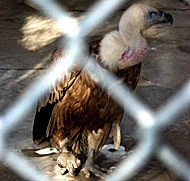
JEDDAH, 29 June 2003 — Vultures generally get a bad press and are fairly unlovable creatures. But beside the Makkah Road there is one, kept in a concrete pen a few meters square, that has an abscess the size of a golfball on one foot. Others are developing on its other foot. It literally hasn’t got a leg to stand on, raising first one then the other to relieve the pain.
Elephants nearby are kept in a tiny space not large enough for one to turn around in.
These animals are in pens and cages that are about as far from their natural environment as it is possible to get.
Animals in captivity are a source of acrimonious debate; some argue that animals are there to be used. Others avow that animals have rights equaling those of humans — another area of contention.
Experts say that the quality of the animals’ enforced habitat should match their natural habitat as far as humanly possible. If we have the right and the ability to capture and keep animals, they argue, then responsibility of care accompanies that right automatically.
Giraffes are herd animals. They walk or run anything up to 100 kilometers a day. On the African savannah, they run apparently in slow motion, with a liquid grace that belies their speed.
Here, however, one is kept on its own, standing immobile for hours on end, in a concrete and steel pen of some 30 square meters.
There is a toothless lioness, and there are chimpanzees showing the classic signs of deep stress (eating their own excrement and running their heads into the bars) and a black bear cub, only a few months old, in a glass cage of less than 3 square meters.
A drive down “Shabab Alley” where the stylish young of Jeddah drive their million-riyal cars past coffee bars and luxury stores and there is more of the same.
An ostrich, confined to a pen that allows movement but is not remotely like the open desert they inhabit, lies slumped on the ground.
In the middle of its back, resembling a miniature volcano with its pus-filled raised rim, is a gaping hole some six or seven centimeters in diameter and much deeper. It’s crawling with flies and the abode of maggots. Occasionally, crows land on the animal’s back attempting a quick snack off the live lunch.
The attendant shrugs his shoulders in a helpless gesture. “What can I do?” The best he can offer is a quick squirt of aerosol antiseptic. The animal will die.
The two-meter crocodile is in a very small pool along with half a dozen turtles. It’s near the white flamingos. White, because their diet doesn’t contain the shrimp and plankton that causes the coloration in the feathers. Half a dozen of these birds stand on a few square meters of concrete in the cage next to the two pelicans.
The animals are for sale.
The Kingdom is a signatory to the Convention in Trade of Endangered Species (CITES) There is certainly a glass box full of Dhub, the local desert reptiles, which are both a protected species and hunted in season. They are for sale — in direct contravention of international and national law.