
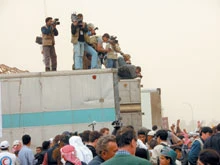
When I was called into my editor in chief’s office during the first week of March, he told me I had been selected to go to Kuwait and then Iraq to cover the war. I was somewhat apprehensive. I weighed it from all sides and decided that career-wise, this was an opportunity I couldn’t pass up. I didn’t know what to expect. My intuition and gut feeling told me I was going to come back home in one piece, alive, with no extra holes.
Though I didn’t know what to expect on this adventure of a lifetime, I knew what my readers expected. That is, accurate, unbiased, and factual reports.
This was going to catapult the paper — and hopefully me — into the international spotlight. This was a career-making or breaking assignment.
I arrived in Kuwait on March 17, three days before the start of the war. From the beginning the plan was to enter Iraq by any means and to trail the armed forces as they made their way north to Baghdad. The first opportunity to enter Iraq from Kuwait presented itself on March 26 in the form of an armed escort into the Iraqi town of Safwan at the Iraqi/Kuwaiti border at the invitation of the Kuwaiti Ministry of Information. I was supposed to report on the Kuwaiti humanitarian relief effort. What ended up happening (my apologies to the Kuwaiti minister of information) was that I saw the opportunity to break away from the minister’s convoy and escape with other journalists further into Iraq. I grabbed my friend, Muhammad Al-Deleami, who was in Kuwait visiting his sister, but accompanying me on that trip to Safwan, and told him I was going to Um Qasr. He decided to tag along.
We ended up staying in Iraq for almost four days, visiting Um Qasr for a day and a half and the Basra area for another two days. The conversations we had with the Iraqi residents of Um Qasr and the people of Basra, Iraq’s southern most cities, led us to believe that these people were for the removal of Saddam at any cost. At that point, civilian casualties were minimal and the food, water and fuel rations the Iraqi people had prepared for the war had not yet been consumed. Of course there were complaints that there was no running water and no electricity, but the war had just started and the residents of those two Iraq cities had not yet become truly desperate for supplies as they did as the days passed.
On the fourth day, British Army personnel ordered my friend and me, as well as Sabine Albertelli, a France TV2 producer, out of Iraq after a group of Italian journalists we were traveling in the same convoy with were arrested by Iraqi police who were, at the time, still in control of Basra. The British didn’t want to lose any more unilateral, non-embedded, journalists to the Iraqis, and provided us with an armed and inflexible escort out of Iraq and to the Sheraton all the way in Kuwait City. During the drive back to Kuwait City, I made several unsuccessful attempts to escape from the British escort as I didn’t know if I would be able to get back into Iraq later.
When I arrived back in Kuwait, I was called by several international radio stations who wanted interviews. I reported what I had seen and heard from the Iraqi people. That is — that they wanted to get rid of Saddam at any cost and that they were for the war. Of course that statement, as true as it was, upset many in the Arab world. One Arab reader wrote, “It is quite apparent that correspondent Essam Al-Ghalib has a UK/USA dog tag around his neck. His approach to the matters is related to his Western-dominated postures which truly classify him as an impostor dressed to please his peers.” Another Muslim reader wrote: “I don’t fully agree with the article written today by Essam. I think he is undecided about whose side of the story he is writing. We as Muslims should be against this unjust war and should make every attempt to show it, even through our writing.”
On the flipside, I was receiving hundreds of e-mails from America and the rest of the world singing my praises as an unbiased reporter. One reader from America wrote: “I live in Washington, DC and make it a priority to try and get information about the war from a wide variety of news sources. I have found real bias in both places, making it very difficult to form a truthful, cohesive picture of what is actually taking place in Iraq. However, I have found that your reporting is a welcome respite from the articles of so many other media sources. I look forward to reading your articles which I find to be unemotional, objective and fair reporting of the events of the war.” Another reader from America wrote: “ I have a question rather than a comment. Are Essam’s articles being read in the Arab World? They are the first articles I’ve read, from that region that seem to be telling the truth about the fear and hate of Saddam. I pray for the people of Iraq! I will continue to read Essam’s work.”
Another reader wrote: “I just saw your interview on CNN, about your experiences recorded in your article, ‘Terrified of Saddam Hussein.’ Great stuff! Since the English Al-Jazeera web site has been hacked, many of my local friends are turning to other English sources within the Arab World for news of the Iraqi war. Being a daily reader of Arab News Online, I am directing them your way! How refreshing to see independent reporting, without the shrill, editorial, and/or ideological elements of some other Arab observers. I understand how difficult and risky it can be to maintain journalistic independence in the Middle East without being embedded in one side or writing for another. Your efforts and communiques are more appreciated and more widely read than you may know.”
Having received literally hundreds of e-mails such as those above, I was encouraged to keep on doing what my job and integrity dictated, which was to report accurately and fairly and without bias. My articles were being printed and reprinted and translated into several other languages, appearing in other publications all over the world. I was taking great pride in my work.
During the week I spent in Kuwait City, preparing for another entry into Iraq, I came across two Portuguese journalists who reported that they had been arrested, beaten and held without food by the US Army Military Police for two days. After some coaxing, they went against their boss’ advice and told me about their ordeal. I reported the story which appeared on page one of Arab News and was carried by Portuguese television and newspapers who received their information from the two journalists themselves. Immediately after that story was printed and appeared on Arab News website, I started to receive a spate of hate mail, now from our American readers. One person wrote: “I served in the US Army’s Special Forces, and am shocked at the depth your paper will sink to in lying. Whoever wrote the article about the two journalists is one sorry excuse for a human being and a bald-faced liar.”
At that point I realized that no matter what the truth really was, if it contradicted people’s own views or opinions, they simply dismissed it as being a lie or a personal attack on their beliefs. I was not to be deterred and I was not going to change the facts as I investigated and found them.
After spending almost a week in Kuwait buying supplies and strategizing for another entry into Iraq, my friend and I set off, again with Sabine Albertelli and other TV journalists, including the two Portuguese journalists, through the desert using GPS, avoiding the Kuwaiti border patrol, as they were the biggest obstacle to our entering Iraq.
(To Be Continued)