JEDDAH/RIYADH/DAMMAM, 7 July 2003 — The announcement on Saturday that Internet cafes have been asked to adhere strictly to the laws regarding monitoring of those who use the Net met with puzzlement from the owners and managers of cafes across the Kingdom. None had been told what new guidelines there were, and when Arab News explained them, they responded with skepticism.
In Riyadh, many owners of cafes said that they had not received any new official guidelines about the operation of the cafes. They said that they were also not aware that the government has tightened restrictions on the use of Net following the revelation that some terrorist suspects were using the facilities of local cafes for information exchange.
Abdul Rahman Al-Rakan of Awad Internet Cafe said the responsibility for a cafe to secure its network adequately “is its own concern.”
Al-Rakan said that the security measures taken by the government were welcome. However, if they were too stringent they would hamper the business of the cafes.
Municipalities, which are the local licensing and regulatory authorities of the Internet cafes in the Kingdom, have already issued a set of rules for cafe owners, said Indian attendant Karim Ali at A.D. Cafe.
The municipality has a standing instruction to the cafes to list the Iqama numbers, ID numbers and names of the customers, Ali said. However, Internet users are reluctant to comply as they are inviting trouble if they do not protect their identity against hackers and viruses.
Traffic on the Net, he said, had jumped substantially since the war on Iraq, which indicates that traffic will soar during a period of disturbance.
Anwar Ahmad, another cafe owner, told Arab News the traffic had also grown rapidly in the wake of the Riyadh bombings.
Ahmad also said that “at any given time, one can find any number of children below the age of 18 surfing the Net.” This appears to contravene the new regulations published in Arab News yesterday.
But he said the majority of the cafe owners contacted by him expressed ignorance of the new rules and regulations released by the government.
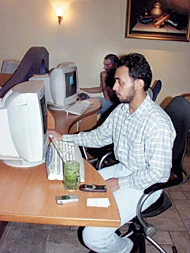
A survey of Internet cafes in Jeddah met mostly with smiling bewilderment. None of the managers contacted was aware of the details of any regulations and few were aware that there were any. None had heard of the move to tighten them.
In none of the cafes had any of the Net users been asked for or offered identity cards, as required by the regulations. Most were regular users and known to the staff on friendly terms.
Managers were also unaware that they could face a prison sentence if they were convicted of breaking the regulations.
Managers and staff at the Internet cafes visited confirmed that a great deal of their business came from under-18s, who officially are not allowed in Internet cafes. “Most of those who come here have Internet access at home,” explained one manager. “They come more to meet friends and have some kind of social life. The sites that the government want to block are blocked anyway, so where’s the harm?”
“I have Internet access for home and business,” said Abdul Rahman Alim, a senior adviser in international marketing. “I use the Internet cafe for a change of environment and the chance to hold meetings in an informal atmosphere.”
He emphasized the social aspects of Internet cafe life. “If you effectively remove a largely innocent aspect of the social life of under-18s, then what are you going to replace it with?” he asked.
Professionally associated with computers, he made another point. “It’s OK having regulations, but enforcing them is going to be expensive and needs trained policemen. I just wonder how many of the police and security staff at street level are computer literate enough to identify and check computer systems.
“Training new staff will be expensive and take time,” he added.
In Dammam and Alkhobar alone there are 200 Internet cafes, and none but a few have been following these regulations. And even those who have been registering users’ names and log-in time are not insisting on identification like Iqamas or national IDs.
“We are doing it as a mere formality, and no one has ever taken it seriously,” said the owner of a cafe in Dammam’s Abdullah Fouad area.
Some cafe owners doubt that the new regulations will be followed completely. “It’s not very practical,” said Ali Al-Jifri, owner of a cafe in downtown Dammam. Jifri’s cafe has been registering users’ name and log-in time.
“We never insisted on ID, because we presumed that the user must be giving correct information.”
Al-Jifri says he will implement the regulations now, though they will increase overheads and paperwork.
Dawood Ali Al-Otaishan, owner of a cafe in Alkhobar, believes the new regulations are “very cumbersome” to follow.
But he admits they may be necessary for national security. “Yes we will do it,” he said. But he said he will have to hire additional staff to register users and keep their IDs safe. “It is a big responsibility and we have to have a member of staff for that purpose alone.”
Cafe owners say that implementation of some of the clauses of the new regulations will cut into their profit. “Already there is tough competition in the market, and these new regulations will cost us more and reduce our profits,” said Muhammad Al-Jishi, owner of a cafe in Dammam.
“We have to understand that gradually Internet cafes are becoming a serious business with a cumulative investment of millions of riyals. There have to be rules to protect the business,” Al-Jishi said.
Almost all cafe owners said that they do not allow their users to visit banned sites. “KACST (King Abdul Aziz City for Science and Technology) has already taken enough measures to block such sites, and we constantly monitor the users. But it is very difficult to observe the users all the time, and sometimes they do go to such forbidden sites. We will now be more particular,” Al-Jishi added.