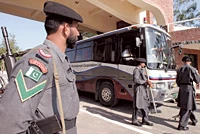
NEW DELHI/WAGAH, 12 July 2003 — It was not the sound of bullets or grenades but that of drums accompanied by dancing that signaled the return of the Delhi-Lahore bus service to the road after a gap of 18 months. The restoration of the service is the most tangible sign yet of easing tensions between the two nuclear powers.
A bus from Pakistan carrying a sick child and 27 passengers ended its historic journey in the Indian capital yesterday. Officials said the green-colored bus that began its journey from the Pakistani city of Lahore early in the day reached the bedecked Ambedkar Stadium bus terminus in the early evening. A reciprocal bus service from India with 32 people on board has already reached Lahore, officials in Pakistan said.
The buses are the first cross-border transport links between the neighbors since ties snapped after the Dec. 13, 2001 attack on the Indian Parliament by gunmen New Delhi claims were backed by Islamabad. Pakistan denies the allegation.
The immense significance the bus-service holds for people on both sides of the border was echoed by the first passengers yesterday. If Abdul Qayoom on the Indian bus was delighted at being able to see his relatives after a long gap, for a two-year old Pakistani girl and her family to be able to come to India for crucial heart surgery meant the world. Little Noor Fatima has two holes in her heart.
“Had the bus service not resumed now, I would have been forced to take my daughter to some Western country for the operation,” Noor’s father Nadeem Sajjad said. Noor’s mother Tayyaba Sajjad expressed her hope that Indian doctors would give Noor a fresh lease of life. While heart operations are common in India, they are still in the initial stages in Pakistan, Nadeem said.
“We are very happy to have reached Delhi. Noor is quite exhausted by the long ride but is in good spirits. Doctors back home told me a Bangalore hospital has the expertise to cure her,” Tayyaba told reporters. “The resumption of the bus service is wonderful — it gives my daughter a chance to get better. We are just so happy to be in India,” she added.
Qayoom said: “I’m very, very happy. I’m going to see my sister after three years.”
The feeling is shared by millions of Muslims spread across both the sides of the Line of Control for whom the 1947 partition meant a division in their families. The majority have remained in touch and meet on special occasions, but the tensions in Indo-Pakistani ties deprived them of the opportunity.
Zubaida Sultan, an Indian married to a Pakistani, was pained at missing her brother’s funeral. As she boarded the bus in Lahore, she said, “I have been waiting to go home by whatever means.”
In Pakistan, Tourism Minister Raess Munir Ahmed said: “We welcome the resumption of the service and hope it will lead to improvement of relations between Pakistan and India.”
And in New Delhi, officials hailed the service to the Pakistani city, but did not forget to admonish Islamabad once again for its alleged support to an Islamic insurgency in Indian Kashmir. About 100 members of the radical Hindu group Shiv Sena, waving black flags and holding placards denouncing Pakistan, jeered the departure of the bus.
—Additional input from agencies